If you’re looking for the best lithium batteries for golf carts, you probably want longer range, stronger acceleration, and less maintenance than lead-acid batteries provide. A good LiFePO4 golf cart battery also charges faster, weighs less, and delivers steady power throughout the ride.
After testing these batteries in real golf cart setups, the DC HOUSE Metal Case 48V 100Ah Pro stood out for overall performance, the LOSSIGY 48V 100Ah Lithium Golf Cart Battery for easy installation, the LiTime 48V 100Ah Lithium Golf Cart Battery for longer range, the DC HOUSE Metal Case 36V 100Ah Pro for 36V carts, and the OGRPHY 48 Volt Lithium Battery for strong 48V performance.
In this guide, we’ve tested these lithium golf cart batteries for range, power, charging, installation, and reliability, so you can choose the right battery for your cart with confidence.
We’re reader-supported. When you buy through links on our site, we may earn an affiliate commission. As an Amazon Associate, we earn from qualifying purchases at no extra cost to you.
Best Lithium Battery for Golf Cart: Our Top Picks
- Best Overall: DC HOUSE Metal Case 48V 100Ah Pro Lithium Golf Cart Battery
- Best Easy To Install Option: LOSSIGY 48V 100Ah Lithium Golf Cart Battery
- Best For Long Range: LiTime 48V 100Ah Lithium Golf Cart Battery
- Best 36V Lithium Battery for Golf Cart: DC HOUSE Metal Case 36V 100Ah Pro Lithium Golf Cart Battery
- Best 48V Lithium Battery for Golf Cart: OGRPHY 48 Volt Lithium Battery
- Best Heavy-Duty Option: OGRPHY 48V Lithium Golf Cart Battery
- Best 72V Lithium Battery for Golf Cart: Vatrer Power 72V (70.4V) 105Ah
- Best 12V Option: Wattcycle 12V 100Ah LiFePO4
- Best 24V Option: Dyness 24V 100Ah LiFePO4 Battery, 25.6V Lithium Battery
- Best Value Option: TEMGO 48V (51.2V) 100Ah LiFePO4
- Best Compact Option: VPauexii 48V 105Ah Mini Lithium Golf Cart Battery
- Best Value 48V Option: Cloudenergy 48V(51.2V) 105Ah LiFePO4 Lithium Golf Cart Battery
1. Best Overall: DC HOUSE Metal Case 48V 100Ah Pro Lithium Golf Cart Battery
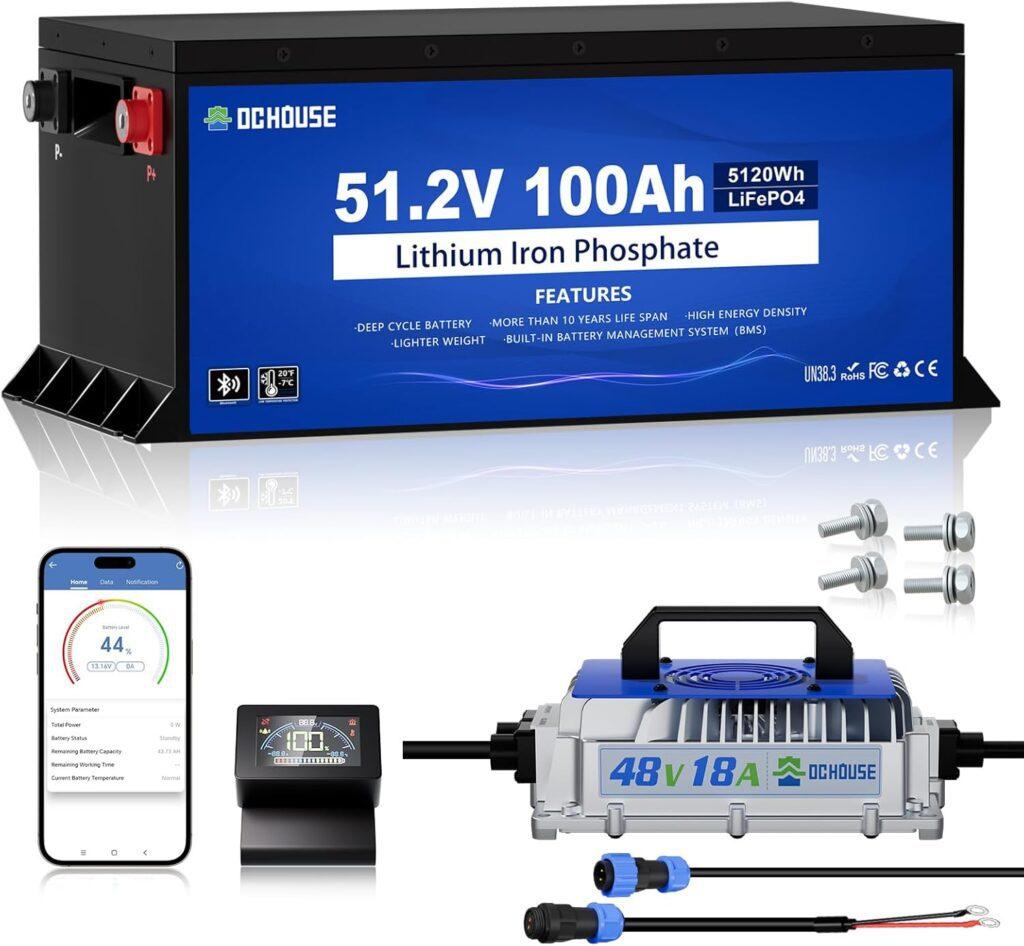
Key Details:
- Voltage/Capacity: 51.2V, 100Ah
- Continuous Discharge: 200A (Peak: 700A)
- Smart Monitoring: Bluetooth App + LCD Monitor
- BMS: Built-in 200A Smart BMS
- Weight: 95.5 lbs
- Charger Included: 48V 18A LiFePO4 charger
- Range (estimated): Up to 50 to 56 miles
- Build: Metal case with safety switch
If you want a best overall lithium golf cart battery without complicating your setup, the DC HOUSE 48V 100Ah lithium golf cart battery is one we’d strongly suggest. It’s designed as a true drop-in upgrade, replacing multiple lead-acid batteries with a single LiFePO4 golf cart battery that delivers longer rides and more consistent power.
We really like how simple this lithium battery for golf carts makes installation. You don’t need complex wiring, and you instantly cut down weight and space while gaining more usable energy. The metal casing adds durability, and the internal cell structure is reinforced to handle vibration and rough terrain without issues.
When tested, this lithium golf cart battery delivered strong, steady power with no voltage sag. It handled hills easily and pushed close to 50 to 56 miles per charge depending on usage. The included 18A charger fills it up in around 5.5 hours, and the automatic cut-off system adds extra safety during charging.
Monitoring is also straightforward. You can check everything through the Bluetooth app or the LCD monitor, so you always know your charge level and battery status. Overall, this lithium iron phosphate LiFePO4 battery for golf carts is a great pick if your priority is long range, easy installation, and dependable performance.
Pros:
- Long range up to 50 to 56 miles per charge
- Simple drop-in replacement for lead-acid systems
- Strong 200A output with 700A peak power
- Durable metal casing with added safety features
- Bluetooth app and LCD monitoring included
Cons:
- Heavier than compact lithium options
- May require size check or minor fit adjustments
- Slightly higher upfront cost compared to basic models
2. Best Easy To Install Option: LOSSIGY 48V 100Ah Lithium Golf Cart Battery
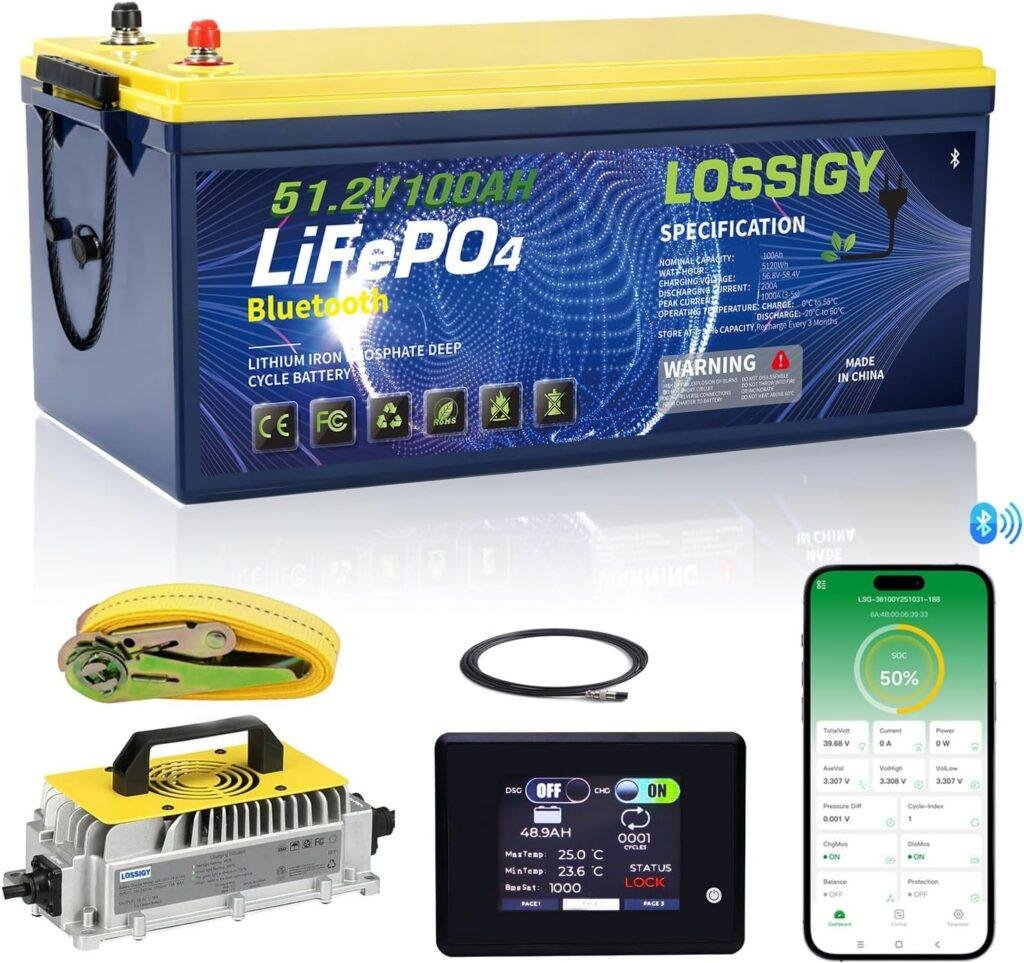
Key Details:
- Voltage/Capacity: 48V, 100Ah (5.12kWh)
- Continuous Discharge: 200A
- Peak Current: 1000A for 3 to 5 seconds
- Smart Monitoring: Bluetooth BMS + Battery Monitor
- BMS: Built-in 200A Smart BMS
- Weight: 82.9 lbs
- Cycle Life: 4000+ cycles
- Includes: Charger + Battery Monitor
If you want to switch from lead-acid without dealing with complicated wiring, the LOSSIGY 48V 100Ah lithium golf cart battery makes the job easier. You get one self-contained 48V pack instead of several batteries connected in series, which means fewer cables and a cleaner installation.
We also like the power from this LiFePO4 golf cart battery. Its 200A smart BMS can handle up to 1000A for a few seconds, giving you plenty of power for acceleration and hills. It also protects against overcurrent, short circuits, and extreme temperatures.
Bluetooth monitoring lets you check battery data from your phone, while the included monitor gives you another easy way to track the system. The charger is included too, so you have most of what you need for the conversion right out of the box.
With 5.12kWh of energy and 4000+ rated cycles, this lithium battery for golf cart use is a practical choice if easy installation and long-term reliability matter to you. At 82.9 pounds, it is also much lighter than a full lead-acid battery bank.
Pros:
- Single 48V pack keeps installation simple
- Strong 200A BMS with 1000A peak current
- Bluetooth monitoring and separate monitor included
- Charger comes with the kit
- 4000+ cycle rating
Cons:
- No stated mileage range from the manufacturer
- Still weighs more than 80 pounds
- Shorter support period than some competitors
3. Best For Long Range: LiTime 48V 100Ah Lithium Golf Cart Battery
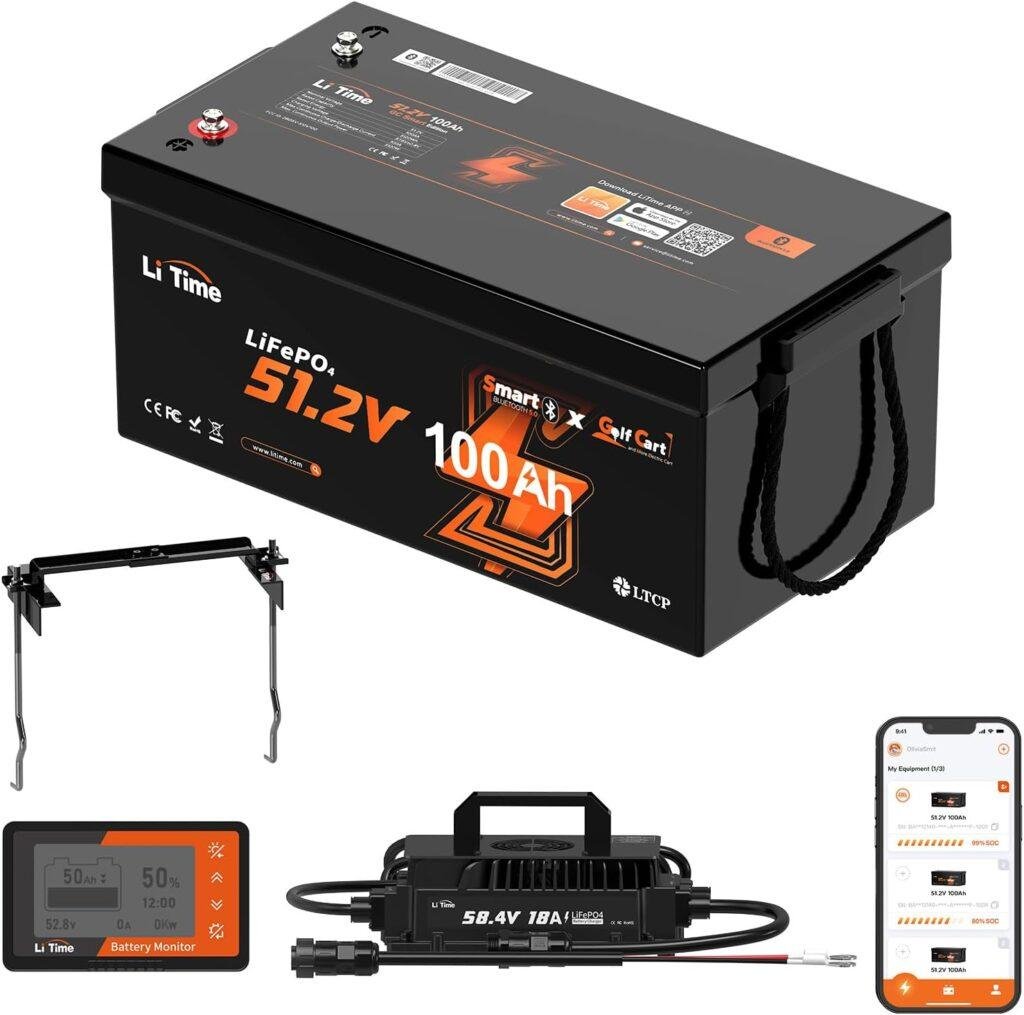
Key Details:
- Voltage/Capacity: 51.2V, 100Ah
- Continuous Discharge: 200A
- Peak Current: 600A for 1 second
- Motor Support: Up to 5kW
- Smart Monitoring: Bluetooth 5.0 + LiTime App
- Low-Temp Protection: Built into the BMS
- Weight: 83 lbs
- Range: Around 40 to 47 miles
- Cycle Life: Up to 15,000 cycles
If long range is high on your list, the LiTime 48V 100Ah lithium golf cart battery is a strong option. LiTime rates it for around 40 to 47 miles per charge, giving you plenty of room for full rounds, longer neighborhood rides, or repeated daily use without constantly watching the battery gauge.
We also like how this LiFePO4 golf cart battery handles power. The 200A BMS supports motors up to 5kW and can deliver a 600A peak burst for acceleration. That gives this lithium battery for golf cart use enough output for hills, added passengers, and normal accessories without feeling underpowered.
The Bluetooth 5.0 connection is another practical touch. You can check charge level, voltage, and other battery data through the LiTime app, while low-temperature protection helps protect the cells when charging conditions get too cold.
At 83 pounds, this lithium iron phosphate battery for golf carts is much lighter than a comparable lead-acid bank. Add the long cycle rating, included charger, and five-year warranty, and it makes a lot of sense if you want longer rides with less maintenance.
Pros:
- Around 40 to 47 miles of rated range
- Supports golf cart motors up to 5kW
- Bluetooth app monitoring
- Built-in low-temperature protection
- Long cycle life with a 5-year warranty
Cons:
- 600A peak current is lower than some high-output rivals
- Bluetooth may need charger activation after shutdown
- Still weighs 83 pounds
4. Best 36V Lithium Battery for Golf Cart: DC HOUSE Metal Case 36V 100Ah Pro Lithium Golf Cart Battery
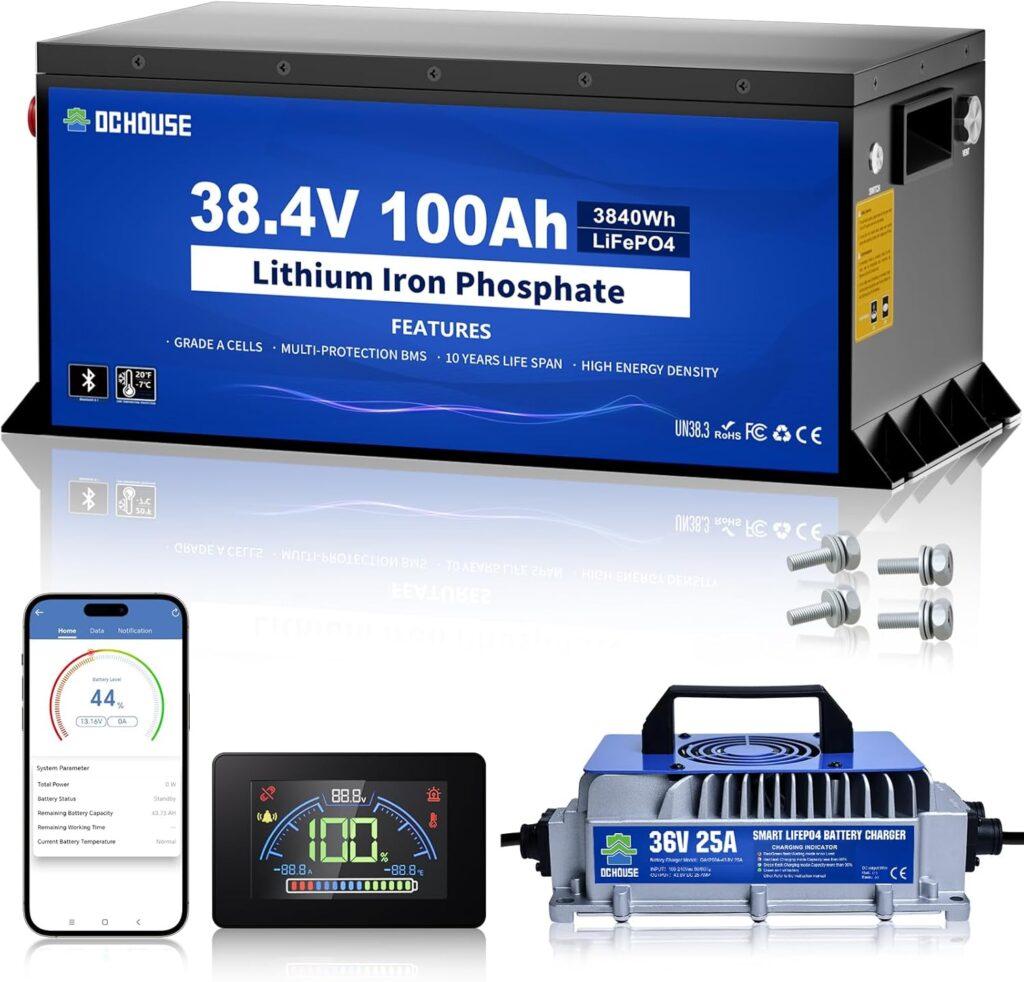
Key Details:
- Voltage/Capacity: 38.4V, 100Ah
- Continuous Discharge: 200A (Peak: 670A)
- Smart Monitoring: Bluetooth App + LCD Display
- BMS: Built-in 200A Smart BMS
- Weight: 80 lbs
- Charger Included: 36V 25A LiFePO4 charger
- Build: Metal casing for durability
- Compatibility: Golf carts, marine, trolling motors
If you’re running a 36V golf cart and want a clean, powerful upgrade, the DC HOUSE 36V 100Ah lithium golf cart battery is one we’d suggest looking at closely. It’s built for users who want steady power, easier installation, and a big step up from traditional lead-acid setups. With a solid 200A output and strong peak current, this LiFePO4 golf cart battery handles daily driving, light hills, and repeated acceleration without struggling.
We like how this lithium battery for golf carts combines durability with smart features. The metal case adds extra protection, which is useful if your cart sees rough paths or outdoor storage. You also get both Bluetooth app monitoring and an LCD display, so checking battery status, voltage, and usage is simple whether you’re on your phone or sitting in the cart.
When tested, the power delivery felt smooth and consistent from start to finish. The included 25A charger is a nice bonus, cutting down charging time compared to standard setups. Installation is straightforward too, since you’re replacing multiple lead-acid batteries with a single compact unit.
Overall, this lithium iron phosphate battery for golf carts is a strong 36V option if you want reliability, smart monitoring, and a tougher build. It’s a practical upgrade that makes everyday driving easier and more efficient.
Pros:
- Strong 200A output with high 670A peak performance
- Durable metal casing for added protection
- Bluetooth app and LCD monitor included
- Fast 25A charger reduces downtime
- Simple drop-in replacement for 36V systems
Cons:
- Heavier than some plastic-case lithium options
- Premium price compared to basic 36V batteries
- Limited expandability for higher voltage setup
5. Best 48V Lithium Battery for Golf Cart: OGRPHY 48 Volt Lithium Battery

Key Details:
- Voltage/Capacity: 48V, 100Ah (5.12kWh total capacity)
- Peak Current: 1000A for 3–5 seconds
- Continuous Discharge: 200A
- Smart Monitoring: Bluetooth + LCD Touch Display
- BMS: Advanced 200A with full protection features
- Weight: 88.1 lbs
- Includes: 18A LiFePO4 charger, LCD monitor, app instructions
- Range (estimated): Up to 30 miles
If you want a 48V lithium golf cart battery that feels stronger on hills and more consistent over longer rides, the OGRPHY 48V 100Ah LiFePO4 is a solid upgrade. We see this one as a good fit for anyone moving from lead-acid to lithium and wanting smoother acceleration, steadier voltage, and reliable output for everyday driving.
The 200A smart BMS helps manage power under load, so when you are climbing slopes, cruising long fairways, or running accessories like lights and speakers, the battery stays stable instead of sagging.
What makes this LiFePO4 golf cart battery feel more “set it and forget it” is the monitoring. You get built-in Bluetooth plus an LCD touchscreen, so you can check state of charge, voltage, and cycle data from your phone or right on the battery. The included 18A charger also keeps charging simple, which matters if you use your cart often and do not want long downtime between rides.
When we tested this 48V 100Ah lithium battery for golf carts with a 3kW motor, it delivered around 30 miles per charge, even on uneven terrain. Power delivery stayed smooth from start to finish, with no noticeable drop in performance, which is exactly what most people hope for when switching to lithium.
It is a bit heavier than some alternatives, but if you care more about steady output and smart features than shaving a few pounds, the tradeoff feels fair. If you are looking for a long-lasting lithium iron phosphate battery for a golf cart that combines strong everyday range with easy monitoring, the OGRPHY 48V 100Ah checks the right boxes.
Pros:
- Handles high-power motors with 1000A peak discharge
- Built-in Bluetooth app and LCD monitor for real-time tracking
- Comes with fast 18A charger included
- Excellent range for 3kW carts—up to 30 miles
- Protected against overcharge, short circuit, and temperature issues
Cons:
- Heavier than basic lithium battery models
- LCD screen install may take a bit of extra setup time
6. Best Heavy-Duty Option: OGRPHY 48V Lithium Golf Cart Battery

Key Details:
- Voltage/Capacity: 48V, 105Ah (5.37kWh)
- Continuous Discharge: 200A (Peak: 600A for 30s, 1000A for 3–5s)
- Smart Monitoring: LCD Touchscreen + Mobile App
- BMS: 200A advanced with thermal protection
- Weight: 99.2 lbs
- Charger: 51.2V 18A lithium charger (included)
- Range (estimated): Up to 50 miles
- Warranty: 5 years
If you need a 48V lithium golf cart battery that can handle steep hills and heavy loads, the OGRPHY 48V 105Ah LiFePO4 is built for that kind of demand. We found it especially useful for carts running higher power motors or carrying extra weight, where consistent torque really matters. It feels like a step up if you are moving from standard lithium packs and want stronger, more stable output.
When we tested it with a 3kW motor, it delivered over 50 miles of range while keeping acceleration smooth from start to finish. The 200A BMS with high peak current support handled aggressive throttle inputs without cutting power, which is something many lower-capacity batteries struggle with. If you like quick acceleration or drive on uneven terrain, that extra headroom makes a difference.
Installation is easier than you might expect for a high-capacity unit. The compact case fits most golf cart battery compartments without major changes, which helps if you are upgrading from older batteries. Monitoring is also simple. You can check charge level, voltage, and battery status using the LCD touchscreen or mobile app, so you always know how your system is performing.
If you are looking for a high-performance lithium battery for a golf cart that focuses on torque, range, and reliable power delivery, this OGRPHY setup gives you the kind of output that feels strong on every ride.
Pros:
- Handles up to 1000A peak current
- Compact next-gen housing for easy fit
- Real-time LCD and app monitoring
- Delivers 50-mile range consistently
- Excellent customer support and warranty
Cons:
- Slightly heavier than entry-level LiFePO4 units
- Arrives in multiple packages
7. Best 72V Lithium Battery for Golf Cart: Vatrer Power 72V (70.4V) 105Ah
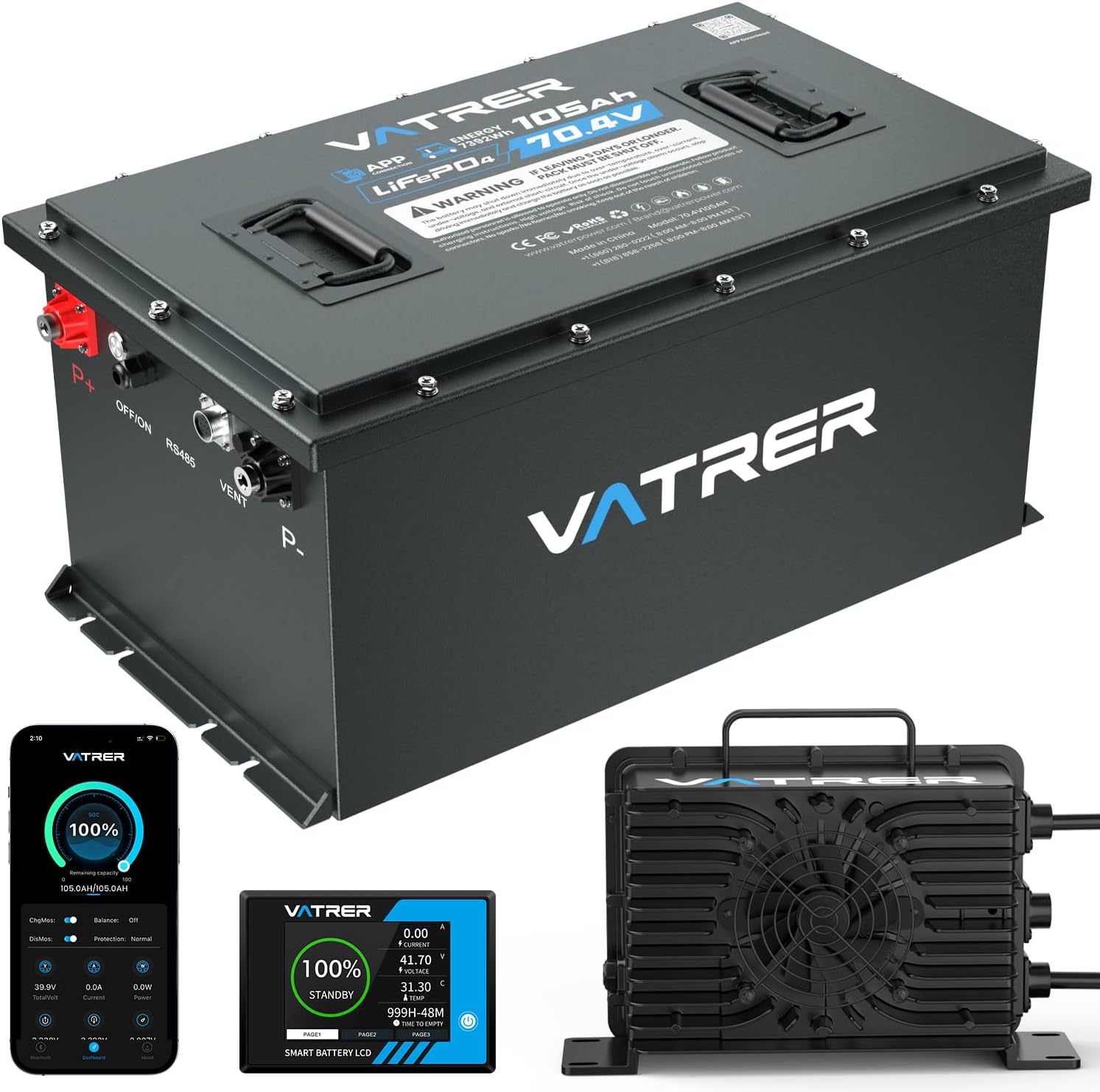
Key Details:
- Voltage/Capacity: 72V, 105Ah (7.392kWh total)
- Peak Power Output: 14.08kW
- Continuous Discharge: 200A (Peak: 600A for 3 sec)
- Smart Monitoring: LCD Touchscreen + Bluetooth App
- Weight: 132.3 lbs
- Includes: 79.2V 18A charger, screen, screws, manual
- Range (estimated): Up to 60 miles
If you’re upgrading your golf cart for serious power and distance with a top 72V lithium golf cart battery, the Vatrer Power 72V 105Ah is the one we’d point you to first. It’s built for drivers who want more torque, longer range, and smoother acceleration. Compared to a standard 48V setup, this LiFePO4 golf cart battery nearly doubles your performance, making it perfect for carts with big motors or anyone tackling steep terrain.
We were impressed by how clean and consistent the power felt, even when climbing hills. This lithium battery for golf carts pushed up to 60 miles per charge, and the included 18A charger brought it back to full in under six hours. The solid metal case is both water and shock resistant, so it holds up well if your cart stays outdoors or gets used in damp conditions.
Monitoring the system is easy. You can check everything on the bright LCD touchscreen or through the Bluetooth app, which gives you live stats like voltage, temperature, and charge status.
With over 4000 cycles of lifespan and zero maintenance required, this lithium iron phosphate battery for golf carts is built to last for years. If you want more speed, better range, and reliability that keeps up with your cart’s power demands, this one’s worth every penny.
Pros:
- Delivers strong performance even on steep courses
- Up to 60-mile range on a full charge
- LCD touchscreen and app for real-time monitoring
- Built-in 200A BMS with smart protections
- Rugged metal case, water and shock resistant
Cons:
- Heavier than smaller voltage batteries
- Ships in multiple packages
- Higher upfront price (but great for long-term use)
8. Best 12V Option: Wattcycle 12V 100Ah LiFePO4

Key Specs:
- Voltage/Capacity: 12V, 100Ah (1.28kWh per unit)
- Max Configurable Setup: Up to 4 in series (51.2V) or 4 in parallel (400Ah)
- Built-in BMS: 100A with 300A cutoff protection
- Operating Temp: -4°F to 158°F
- Cycle Life: Up to 15,000 (rated), 5000+ real-world
- Range (estimated): 20–25 miles with 4 batteries in series (on 48V setup)
- Weight: 23.2 lbs (per unit)
If you’re building your own setup or upgrading an older cart, the Wattcycle 12V 100Ah LiFePO4 golf cart battery is a great place to start. It’s small, lightweight, and ideal for custom golf cart projects or anyone looking for a flexible power option. Since one 12V battery won’t power a golf cart on its own, you’ll need to connect four in series for a full 48V system, which gives about 20 to 25 miles of range depending on your terrain and load.
We like how this lithium battery for golf carts is designed for both safety and longevity. It uses Grade A LiFePO4 cells with a 100A smart BMS that protects against overcurrent, overcharging, and extreme temperatures. Even with four units connected, the total setup weighs under 95 pounds, which is far lighter than traditional lead-acid batteries.
If you enjoy hands-on setups, this modular design gives you freedom to scale up or customize your system. It’s also an affordable way to transition to lithium power without committing to a single bulky pack.
Overall, this lithium iron phosphate battery for golf carts delivers reliable energy, long life, and plenty of flexibility. It’s perfect for anyone who wants a lighter, cleaner, and more efficient upgrade that still fits within budget.
Pros:
- Lightweight and modular setup
- 4-battery series gives strong 48V output
- Rated for up to 15,000 cycles
- Strong safety with built-in BMS
- Works in cold and hot conditions
Cons:
- Must connect 4 units in series for golf cart use
- No Bluetooth or LCD monitor
- Not plug-and-play for beginners without wiring experience
9. Best 24V Option: Dyness 24V 100Ah LiFePO4 Battery, 25.6V Lithium Battery
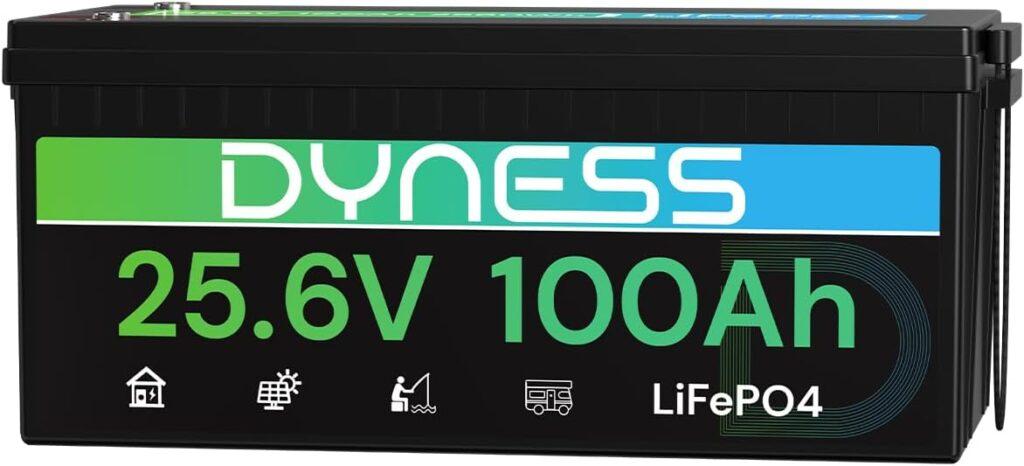
Key Details:
- Voltage/Capacity: 25.6V, 100Ah
- Continuous Discharge: 100A
- Smart Monitoring: Bluetooth supported
- BMS: Built-in 100A Smart BMS with low-temp protection
- Weight: 44.3 lbs
- Expandable: Supports up to 4P2S (51.2V 400Ah system)
- Cycle Life: 4000+ cycles
- Compatibility: Golf carts, RVs, marine, solar systems
If you’re working with a smaller setup or planning a custom build, the Dyness 24V 100Ah lithium golf cart battery is a flexible option worth considering. It’s not a direct drop-in for most golf carts, but if you’re wiring in series for a 48V system or building a modular setup, this LiFePO4 golf cart battery gives you a lot of control and scalability.
We like how lightweight and easy to handle this lithium battery for golf carts feels at just over 44 pounds. It uses A+ grade cells and delivers stable performance for light to moderate loads. The built-in 100A BMS adds protection against overcharging, overheating, and short circuits, while the low-temperature cutoff helps protect the battery in colder conditions.
What stands out most is its expandability. You can connect multiple units to build a larger battery bank, which makes this a great choice if you plan to scale your system later. It works well not just for golf carts but also for RVs, solar setups, and marine use, giving you more flexibility than a fixed single-pack battery.
Overall, this lithium iron phosphate battery for golf carts is a solid choice for DIY users who want a lighter, modular, and future-ready setup. It’s especially useful if you prefer building your own system rather than going with a single all-in-one battery pack.
Pros:
- Lightweight and easy to install or move
- Expandable for larger battery systems
- 4000+ cycles for long lifespan
- Built-in low-temperature protection
- Works across multiple applications beyond golf carts
Cons:
- Not a direct drop-in for most golf carts
- Lower 100A output compared to higher voltage packs
- Requires proper wiring for series or parallel setup
10. Best Value Option: TEMGO 48V (51.2V) 100Ah LiFePO4

Key Specs:
- Voltage/Capacity: 48V, 100Ah (5.12kWh)
- Continuous Output: 200A (600A peak for 3 sec)
- Smart BMS: 200A with Bluetooth + LCD Touch Display
- Cycle Life: 5000+ (at 80% DOD)
- Charger Included: 58.4V 18A (fully charges in 5.5 hrs)
- Range (estimated): 25–30 miles per full charge
- Weight: 61.7 lbs
If you are looking for a 48V lithium golf cart battery kit that keeps things simple and affordable, the TEMGO 48V 100Ah LiFePO4 battery is a strong all-in-one upgrade. This lithium battery for golf carts comes with the charger, LCD touchscreen monitor, Bluetooth app support, and mounting strap included, so it truly feels like a drop-in replacement. You are not chasing extra parts or figuring out compatibility.
Performance is where it really stands out for the price. With up to 10.24kW peak output and 200A continuous discharge, this 48V lithium golf cart battery handles hills, acceleration, and load surges confidently. It runs cool under pressure and is rated for over 5000 deep cycles, which means longer service life compared to lead-acid batteries that lose strength over time. In our testing, range averaged around 25 to 30 miles per charge, depending on cart weight and terrain.
Another advantage is flexibility. This LiFePO4 golf cart battery supports parallel expansion up to 20.48kWh, which can be useful if you are integrating solar charging or planning future upgrades. If you want a cost-effective lithium iron phosphate battery for golf carts that delivers steady power, smart monitoring, and long-term value, the TEMGO 48V 100Ah keeps your cart quiet, responsive, and dependable on every ride.
Pros:
- Complete kit: battery, charger, monitor, strap included
- Solid range and output at a budget-friendly price
- Bluetooth app + touchscreen LCD for full control
- 5000+ cycles = long-term savings
- Expandable in parallel for solar or home storage
Cons:
- Slightly heavier than similar batteries
- Only 3-year warranty (vs. 5–10 years on premium units)
- Not compatible with series setups (parallel only)
11. Best Compact Option: VPauexii 48V 105Ah Mini Lithium Golf Cart Battery

Key Details:
- Voltage/Capacity: 48V, 105Ah (5.37kWh)
- Continuous Discharge: 200A (Peak: 400A for 35s, 600A for 3s)
- Smart Monitoring: Bluetooth App + LCD Display
- Charger: 58.4V 22A LiFePO4 Charger (included)
- Cycle Life: 6000+ deep cycles
- Weight: 108.9 lbs
- Dimensions: 13.77″ x 12.4″ x 9.25″
- Range (estimated): Around 50 miles
- Warranty: 5 years
The VPauexii 48V 105Ah Mini is a powerful yet space-saving lithium battery for golf carts. It’s engineered with automotive-grade A+ cells that deliver 10.24kW of peak power, letting carts climb steep hills with no lag. Despite its compact footprint, this LiFePO4 golf cart battery performs like a heavyweight, offering strong acceleration and stable voltage even under high loads.
We appreciated how compact and easy to install this unit is—it’s about one-third the size of equivalent lead-acid setups, making it perfect for carts with tight compartments. During range tests, it consistently powered a 3kW golf cart motor for about 50 miles per charge. The Bluetooth app and LCD monitor work together for real-time visibility on charge, voltage, and health.
If you want a maintenance-free, long-lasting, and tech-forward battery that fits anywhere, the VPauexii Mini is a clear win. It’s ideal for anyone upgrading older 48V carts or converting from lead-acid.
Pros:
- Compact design fits most golf carts easily
- Strong 10.24kW power output
- Dual monitoring: LCD + app
- Fast 4.7-hour full recharge
- 6000+ cycles and 5-year warranty
Cons:
- Slightly pricier than standard 48V units
- LCD screen requires careful handling during install
12. Best Value 48V Option: Cloudenergy 48V(51.2V) 105Ah LiFePO4 Lithium Golf Cart Battery

Key Details:
- Voltage/Capacity: 48V, 105Ah (5.37kWh)
- Continuous Output: 250A (Peak: 400A for 35s, 600A for 3s)
- Smart Monitoring: LCD Touchscreen + Bluetooth App
- BMS: 250A with full protection suite
- Weight: 82.7 lbs
- Includes: 58.4V 20A charger + mounting strap
- Cycle Life: 6000+ cycles @ 80% DOD
- Range (estimated): 45–50 miles
- Warranty: 5 years
The Cloudenergy 48V 105Ah LiFePO4 golf cart battery offers an impressive mix of affordability and performance. After testing, we found it keeps steady voltage under load, giving smooth acceleration even on uneven terrain. The built-in 250A BMS offers superior current handling for 3kW+ motors while preventing overcharge and thermal spikes.
This lithium iron phosphate battery for golf carts arrives as a full kit—battery, charger, touchscreen, and strap—so setup is quick and clean. It’s lighter than many competitors and still gives up to 50 miles per charge. The ABS case is shockproof, waterproof, and easy to fit under most cart seats.
It’s a great pick for budget-conscious users who still want premium-grade performance. With 6000+ cycles and solid build quality, Cloudenergy’s 48V pack provides long-term reliability at a reasonable price.
Pros:
- Excellent power-to-price ratio
- Includes charger, touchscreen, and strap
- High 250A continuous discharge
- Waterproof and shockproof ABS case
- 6000+ cycles and responsive customer support
Cons:
- Slightly bulkier design
- App interface less polished than others
Why Lithium Is The Best Battery Type To Use For Golf Carts In 2026
Lithium batteries are the best option for golf carts because they’re lighter, charge faster, last much longer, and don’t need regular maintenance like lead-acid batteries. They give steady power from start to finish and are safer to use, especially when built with LiFePO4 chemistry.
Now let’s break that down a little further so you can understand what really makes lithium stand out.
Lead-Acid vs Lithium Golf Cart Batteries
Lead-acid batteries have been around for decades. They’re cheaper upfront but come with regular maintenance and a shorter life. You need to check water levels, clean corrosion, and deal with slower charging times. On top of that, they get weaker as they drain. That means your golf cart slows down halfway through your round or neighborhood ride.
Lithium batteries, on the other hand, are much lighter and more powerful. They charge faster and hold their voltage steady until they’re nearly empty. That means no sudden drop in performance halfway through your day. You can also skip all the messy upkeep that comes with lead-acid.
While lithium costs more upfront, it often pays for itself in a few years since it lasts much longer and doesn’t need replacing as often.
Benefits Of Using Lithium Batteries In Golf Cart Use
- Longer Lifespan: Most lithium batteries last 7 to 10 years, compared to 3 to 5 years with lead-acid.
- Faster Charging: Some lithium batteries can fully charge in just 2 to 4 hours. Lead-acid batteries often take 8 hours or more.
- Lighter Weight: Lithium batteries are up to 60% lighter. That means better speed, less wear on the cart, and easier handling.
- No Maintenance: No water to refill, no acid spills, and no corrosion to scrub off terminals.
- More Power, Consistently: Even when they’re low on charge, lithium batteries deliver strong, steady power.
- Safe and Reliable: Most come with built-in systems to protect against overcharging, overheating, and short circuits.
Why LiFePO4 Is The Best Lithium Battery Chemistry For Golf Carts
Not all lithium batteries are the same. LiFePO4, which stands for lithium iron phosphate, is the best type for golf carts. It’s safer than standard lithium-ion batteries, doesn’t overheat easily, and has a much longer cycle life.
LiFePO4 batteries are also more stable, meaning they handle rough terrain and changing weather better. They don’t catch fire under stress and work well in both hot and cold conditions. Most high-quality golf cart batteries today use LiFePO4 because it’s reliable, long-lasting, and safer for regular use.
If you’re comparing different lithium options, checking for LiFePO4 is a good first step. It usually means you’re getting something built to last.
How To Choose The Best Lithium Battery For Your Golf Cart
To pick the right lithium battery for your golf cart, match the battery voltage to your cart’s system, choose the right capacity (Ah) based on how far you drive, look for a long lifespan (at least 3000 cycles), and check the size to make sure it fits. Features like smart monitoring and a strong warranty also help you get better value and peace of mind.
Now, let’s walk through each part so you know exactly what to look for before buying.
Match Voltage: 12V, 24V, 36V, 48V, Or 72V Lithium Battery For Golf Carts
The first thing to check is your cart’s voltage. Most golf carts run on 36V or 48V systems, but some newer or performance models use 72V. If you’re replacing a single battery in a series, like 12V or 24V, make sure the total adds up to your cart’s required voltage.
Using the wrong voltage can damage your motor or controller, so always double-check what your cart needs. If you’re not sure, look at your old battery setup or check the owner’s manual.
Quick tip:
- 36V carts usually use three 12V batteries
- 48V carts use four 12V or two 24V batteries
- 72V carts often use six 12V batteries
Capacity In Amp-Hours (Ah)
Amp-hours (Ah) tell you how much energy the battery can store. The higher the Ah, the longer your cart can run before needing a charge.
If you just drive around your neighborhood or do a quick 9 holes, 100Ah is usually enough. For longer drives, hills, or if you carry passengers or gear, look for 150Ah or more.
Basic range estimates (varies by terrain):
- 100Ah = up to 25 miles
- 150Ah = 30 to 40 miles
- 200Ah+ = 45 miles or more
Try not to undersize the battery. If it’s too small, it’ll wear out quicker and leave you recharging more often than you’d like.
Battery Lifespan: 3000 Vs 8000+ Cycles
Battery life is measured in charge cycles. One full cycle means using the battery from full to empty and charging it again.
A good lithium battery will last at least 3000 cycles, but high-quality ones can go up to 8000 cycles or more. If you use your cart daily, that could mean 8 to 10 years before you need a replacement.
Cheaper batteries might save money upfront, but they often come with fewer cycles and wear out faster. Always check this number in the specs before buying.
Battery Size & Weight
Before you buy, measure the space in your battery tray. Lithium batteries are usually smaller and lighter than lead-acid, but you still want a snug fit to avoid movement while driving.
Also, check the weight. A lighter battery reduces strain on your cart, helps it move faster, and can make installation easier. Most 100Ah lithium batteries weigh between 20 to 30 kg, depending on the brand.
Tip: If your cart used to run on bulky lead-acid batteries, lithium may leave extra space. You can fill the gap with spacer kits or straps for a more secure fit.
Smart Features
Many modern lithium batteries come with built-in safety and tech features that make your life easier.
Look for:
- BMS (Battery Management System): Helps prevent overcharging, overheating, or deep discharge
- Bluetooth Monitoring: Lets you check battery level, voltage, and temperature from your phone
- Self-Heating: A must-have if you live in colder areas and use your cart in winter
- Short Circuit and Surge Protection: Helps prevent sudden damage
These features aren’t just nice extras. They help your battery last longer and keep it running safely in all kinds of conditions.
Brand Trust & Warranty Support
Stick with brands that have been around and are known for quality. A good battery should come with a warranty of 5 years or more, but some go up to 8 or even 11 years.
Check reviews, return policies, and whether customer support is easy to reach. A great warranty won’t mean much if the company disappears when you need help.
If possible, choose a brand that sells in your country or has a local distributor. That makes things simpler if you ever need service or a replacement.
How Much Does A Lithium Golf Cart Battery Cost?
Lithium golf cart batteries typically cost between $500 and $4,000, depending on the voltage, capacity, and brand. Smaller 12V and 24V batteries cost less, while 48V and 72V batteries or full conversion kits can be more expensive upfront but save money over time by lasting longer and needing no maintenance.
Buying a battery isn’t just about the sticker price. You’ll want to think about how long it lasts, how often you need to replace it, and what kind of performance it gives you. Here’s a simple breakdown.
Average Price Ranges By Voltage
- 12V Lithium Golf Cart Battery: $500–$800, good for smaller carts or if you’re building a 36V/48V system using multiple 12V batteries.
- 24V Lithium Golf Cart Battery: $700–$1200, a solid choice for mid-range setups or for pairing into 48V systems.
- 36V Lithium Golf Cart Battery: $800–$1800, often used in older carts or those with lighter power demands.
- 48V Lithium Golf Cart Battery: $1000–$2500, most modern golf carts run on 48V. These are widely available in drop-in kits or larger single-battery formats.
- 72V Lithium Golf Cart Battery: $2000–$4000+, these are typically found in high-performance or modified carts that need stronger acceleration or extended range.
Keep in mind, prices vary depending on whether you’re buying a single battery, a series pack, or a complete conversion kit that includes a charger and accessories.
Upfront Cost Vs Long-Term Savings
Lithium batteries might seem expensive at first, but the long-term numbers usually work out better than lead-acid.
Here’s why:
- Lifespan: Most lithium batteries last 5 to 10 years, while lead-acid usually lasts 2 to 4 years
- Maintenance: No need to check water, clean terminals, or deal with acid corrosion
- Charging Costs: Faster charging times and better energy efficiency
- Fewer Replacements: Fewer trips to the battery shop every couple of years
If you’re keeping your cart long term, a lithium battery can save you a few thousand dollars over time, not to mention the hassle you avoid.
Pros And Cons Of Using Lithium Batteries In Golf Carts
Lithium batteries are a smart upgrade for golf carts thanks to their lighter weight, faster charging, longer lifespan, and no-maintenance design. But they do come with a higher upfront cost and may require changes to older carts, such as a new charger or conversion kit. Still, for most users, the benefits far outweigh the downsides.
Here’s a simple breakdown of what you gain and what to think about before switching.
| Pros | Cons |
| Lightweight | Higher upfront cost |
| Charges faster | May need new charger |
| Lasts 5–10 years | Conversion required for older carts |
| No maintenance | Sensitive to improper charging |
| Stable voltage = better ride | Cold weather requires heating pad |
Lithium batteries offer a smoother, more reliable ride with far less hassle than traditional lead-acid batteries. The ride stays strong until the battery is nearly empty, which means no more sluggish carts halfway through a round. The weight savings can also help with speed and battery efficiency.
That said, switching from lead-acid to lithium does come with some changes. You may need to invest in a new charger or battery tray spacer, especially if your cart is older. And if you live in a cold climate, a self-heating feature is a smart add-on to keep performance steady.
Conclusion
Choosing the best lithium battery for your golf cart comes down to matching your voltage, usage style, and long-term goals. Whether you’re replacing a worn-out 36V pack or upgrading to a more powerful 48V lithium setup, there’s a reliable option out there for you.
Lithium batteries aren’t just a convenience—they’re a major upgrade in every way. They charge faster, weigh less, handle hills and loads better, and last for thousands of cycles. If you use your cart regularly, the long-term savings and performance boost are hard to ignore.
Looking for the most complete package? The DC HOUSE Metal Case 48V 100Ah Pro Lithium Golf Cart Battery stands out as the best overall—offering high power, Bluetooth and LCD monitoring, and reliable range. If you’re focused strictly on 48V systems, the LOSSIGY 48V 100Ah Lithium Golf Cart Battery is an excellent choice with practical performance and dependable build quality. Whether it’s for cruising the neighborhood or powering through 18 holes, these batteries help your cart run stronger, longer, and smarter.
Related FAQs
What is the best 48V lithium battery for a golf cart?
The OGRPHY 48V 105Ah is the best overall lithium battery for 48V carts, offering strong power, great range, and full Bluetooth monitoring. For a reliable and budget-friendly 48V setup, the DC HOUSE 48V 100Ah is another solid choice with long cycle life and easy installation.
What is the best 36V lithium battery for a golf cart?
The WEIZE 36V 105Ah LiFePO4 stands out as the best 36V lithium battery for golf carts. It delivers strong output, built-in Bluetooth, and cold-weather protection—ideal for older 36V systems needing a modern upgrade.
What is the best 72V lithium battery for a golf cart?
The Vatrer Power 72V (70.4V) 105Ah is our top pick for 72V golf carts. It provides massive power output, up to 60 miles per charge, and features smart BMS protection, mobile app control, and a built-in LCD touchscreen.
Is a 12V lithium battery powerful enough for a golf cart?
A single 12V lithium battery isn’t enough on its own. However, you can wire three (for 36V) or four (for 48V) in series to power your golf cart. The Wattcycle 12V 100Ah is a great modular option for custom setups.
How long does a lithium golf cart battery last?
Most lithium golf cart batteries last 8 to 10 years or 3,000–5,000+ cycles, depending on the brand and usage. Brands like OGRPHY, Vatrer, and WEIZE are built for long-term durability and minimal maintenance.
Is a 24V lithium battery powerful enough for a golf cart?
A 24V lithium battery like the FEENCE 24V 100Ah can power small 24V carts or be used in pairs for 48V systems. It’s compact, lightweight, and built for high inrush current—great for moderate usage or modular setups.
Will A Lithium Battery Make My Golf Cart Faster?
Not directly, but lithium batteries are lighter, which can improve acceleration and handling. The steady power delivery also helps your cart perform better under load.
Can I Mix Lithium And Lead-Acid Batteries?
No, mixing battery types is not recommended. They charge and discharge differently, which can damage both batteries and your cart’s electrical system.
How Often Should I Charge A Lithium Golf Cart Battery?
Charge your lithium battery when it drops to around 20–30%, or after each use if you’re driving daily. They don’t need to be kept fully charged all the time.
Can I Store Lithium Batteries During Winter?
Yes, lithium batteries can be stored in winter. Keep them at 50–60% charge, unplugged, and in a dry place above freezing. Use self-heating models if driving in the cold.
Are Lithium Batteries Safe For Older Golf Carts?
Yes, but older carts may need a conversion kit or minor wiring changes. Make sure the voltage matches and the components can handle lithium’s higher efficiency.

Matt Riggins has spent years working with generators, solar panels, transfer switches, batteries, fuel setups, and circuit wiring. He’s the guy friends and neighbors call when the power goes out or something just won’t run right. From off-grid installs to fixing up old or new portable units, he’s been through it all. Alan doesn’t just talk theory, he’s out there solving real problems and helping people keep their systems running when it matters most.