If you’re shopping for the best 12 volt lithium batteries for RV, you’re probably done with voltage drop, slow charging, and batteries that fade after a couple seasons. A 12V LiFePO4 RV battery gives you steadier power for fridges, lights, fans, and inverters, plus faster recharging and longer cycle life, so you can camp longer without stressing about your power overnight.
After testing these batteries in RV-style use, these picks stood out: LiTime 12V 230Ah Bluetooth LiFePO4 Battery for balanced performance, VATRER POWER 12.8V 300Ah Self-Heating LiFePO4 Bluetooth for self-heating cold-weather use, NewtiPower 12V 300Ah Small LiFePO4 Lithium Battery Small for compact 300Ah fitment, Dumfume 12V 300Ah Lithium LiFePO4 Battery for budget-friendly capacity, and Battle Born 100Ah 12V Lithium-Ion (LiFePO4) for proven long-term value.
In this guide, we’ve tested these 12V lithium RV batteries for usable capacity, voltage stability under load, charging speed, safety features, and real-world fitment, so you can confidently choose the right LiFePO4 battery for your RV and stop worrying about power on the road.
We’re reader-supported. When you buy through links on our site, we may earn an affiliate commission. As an Amazon Associate, we earn from qualifying purchases at no extra cost to you.
Best Lithium Battery for RV: Our Top 7 Picks
- Best Overall: LiTime 12V 230Ah Bluetooth LiFePO4 Battery
- Best Self-Heating Option: VATRER POWER 12.8V 300Ah Self-Heating LiFePO4
- Best 300Ah Compact Option: NewtiPower 12V 300Ah Small LiFePO4 Lithium Battery
- Best Budget Option: Dumfume 12V 300Ah Lithium LiFePO4 Battery
- Best Value Option: Battle Born 100Ah 12V Lithium-Ion (LiFePO4)
- Best Compact Bluetooth Option: Wattcycle 12V 314Ah Mini LiFePO4 Lithium Battery
- Best All-Weather Option: TEMGOT 12V 300Ah Self-Heating LiFePO4
1. Best Overall Option: LiTime 12V 230Ah Bluetooth LiFePO4 Battery
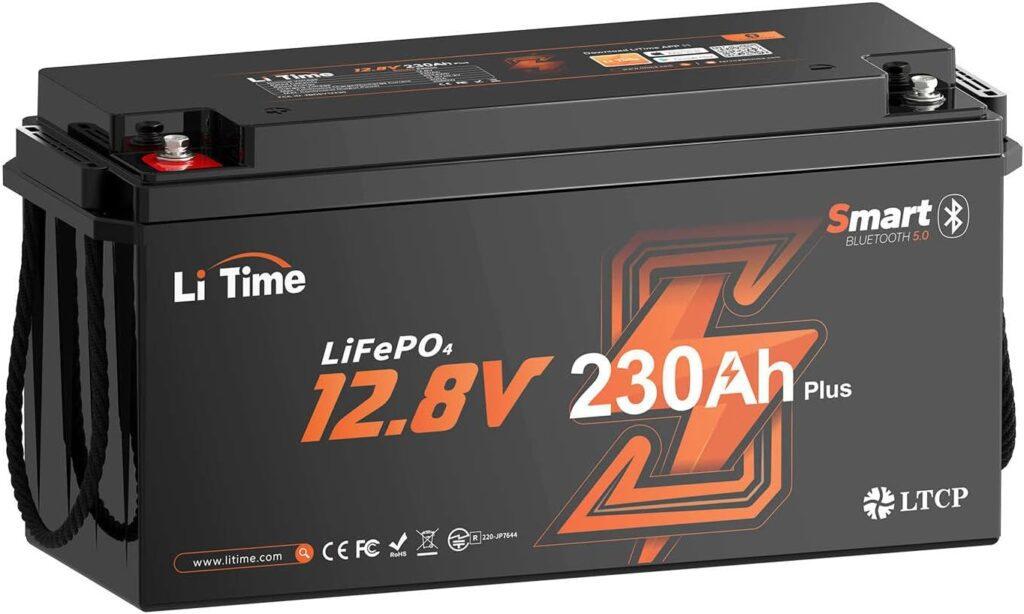
Key Specifications:
- Capacity: 230Ah (2944Wh max energy)
- BMS: 20+ protection features with Bluetooth 5.0
- Weight: around 50 lbs
- Low-temperature cutoff for charging and discharging
- Expansion: up to 16 batteries for 48V 920Ah systems
If you’re upgrading to a 12V lithium battery for an RV and you want more capacity without constant guesswork, the LiTime 12V 230Ah LiFePO4 with Bluetooth is a really solid option. We like how the Bluetooth app makes day-to-day use easier. You can check voltage, temperature, and state of charge from your phone, so you know where you stand before you fire up an inverter or settle in for the night.
Safety and durability are a big part of why this lithium RV battery works well for travel. The built-in BMS provides multiple protections for overcharging, over-discharge, short circuits, and temperature extremes. The IP65-rated housing helps with dust and moisture, and the low-temperature cutoff protects the cells when you’re camping in colder weather.
If you rely on solar or spend a lot of time off-grid, expandability is where this battery really helps. You can build a larger 12V battery bank for an RV by adding more batteries, which increases usable energy for lights, water pumps, fridges, fans, and higher-draw appliances. If we were putting together a dependable LiFePO4 RV battery bank for longer stays, this LiTime 230Ah would be high on the list because it combines high capacity, easy monitoring, and a setup that can grow with your power needs.
Pros:
- Bluetooth 5.0 monitoring for stress-free power checks
- Strong BMS protections and cold-weather cutoff
- Expandable for large off-grid setups
- 4000 plus cycle life with stable voltage
Cons:
- No built-in heating for below-freezing charging
- Costs more than smaller LiFePO4 RV battery options
2. Best Self-Heating Option: VATRER POWER 12.8V 300Ah Self-Heating LiFePO4
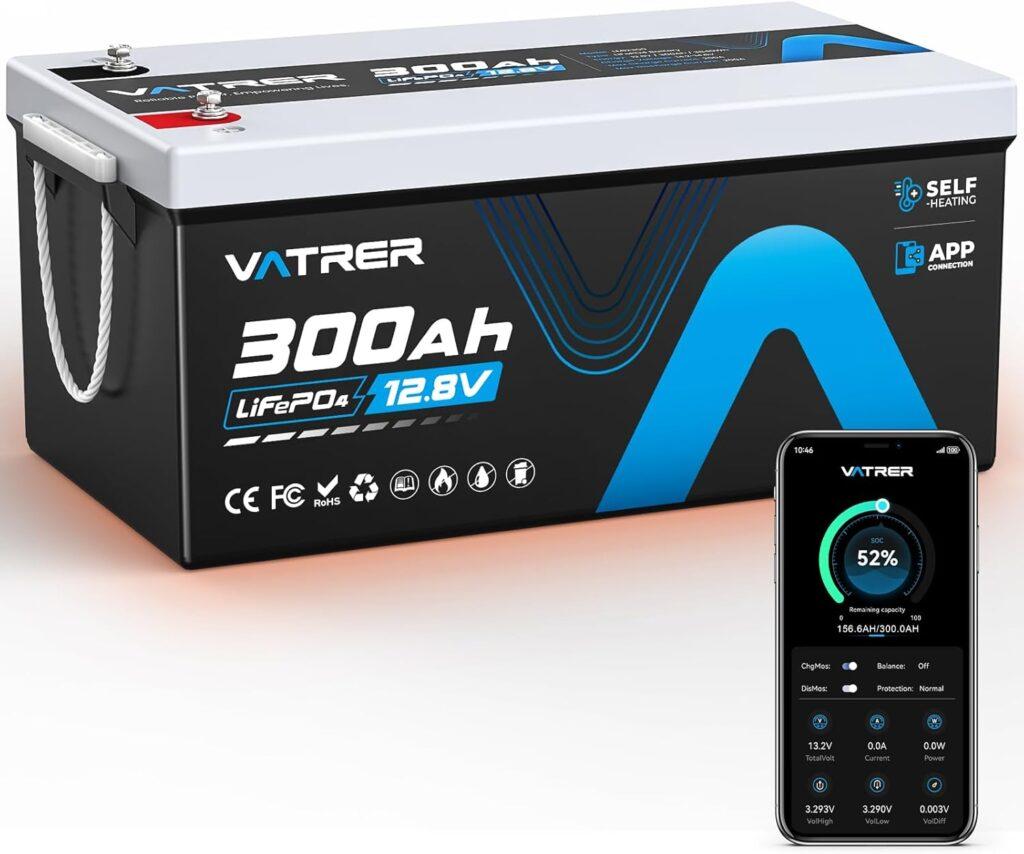
Key Specifications
- Capacity: 300Ah, 12.8V (3840Wh usable energy)
- Weight: 58.4 lbs
- Size: 20.47″D x 13.86″W x 8.66″H
- BMS: 200A Smart BMS with self-heating pads
- Cold Temp Charging: Works down to -4°F with auto heat activation
- Lifespan: 5,000+ cycles
- Smart Monitoring: Bluetooth-enabled
If you camp in winter or travel through cold regions, the VATRER POWER 12.8V 300Ah LiFePO4 battery with self-heating is the kind of upgrade that takes stress off your RV power setup. The built-in heating pads warm the cells automatically before charging starts, so you can charge safely in temperatures down to about -4°F. That means if we are plugged into shore power or charging from solar on a cold morning, the battery protects itself without you having to babysit it.
Cold-weather features aside, it is also a strong 12V lithium RV battery for higher-demand systems. The 200A BMS supports heavier loads and adds protection against overcharge, over-discharge, short circuits, and temperature issues. You also get Bluetooth monitoring, so you can check voltage, temperature, and state of charge from your phone, which is useful when the battery is tucked into a compartment. With Grade A LiFePO4 cells and UL-focused safety design, it is built for stable output and long service life.
One important note is compatibility. This heated model is not designed to be mixed with non-heated versions in a series or parallel bank. But if you are building a matched setup or running a single large-capacity battery for off-grid RV camping, this one makes a lot of sense. If you want reliable lithium power in cold weather, the VATRER POWER 12.8V 300Ah keeps charging safe and keeps your RV power steady when temperatures drop.
Pros:
- Self-heating allows safe charging in sub-freezing temps
- 200A BMS with full smart protection
- Bluetooth monitoring app included
- Long 5,000+ cycle life
- Safer lithium chemistry, UL-tested
Cons:
- Can’t be mixed with non-heated batteries in series/parallel
- Slightly larger footprint than compact models
- Heating function requires at least 10A charging current to activate
3. Best 300Ah Compact Option: NewtiPower 12V 300Ah Small LiFePO4 Lithium Battery
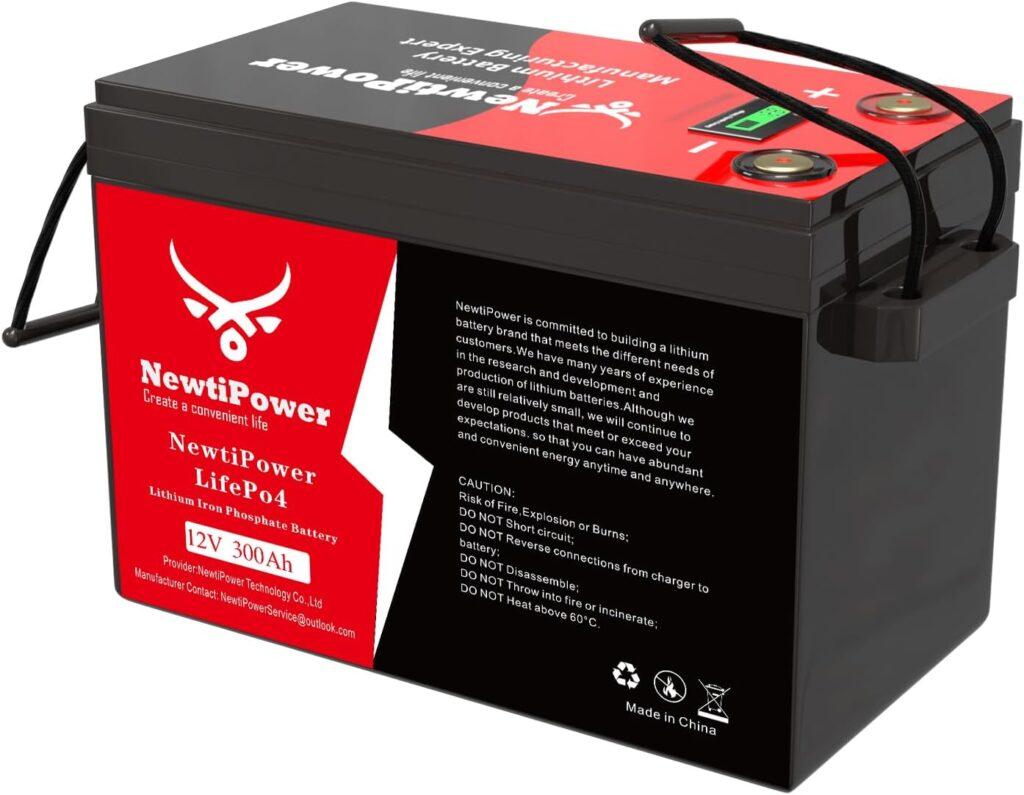
Key Specifications:
- Capacity: 300Ah (3840Wh), 12.8V
- Weight: 56 lbs
- Dimensions: 15.2 x 7.6 x 9.8 in
- Battery Management: 200A Smart BMS with temp protection
- Connectivity: Bluetooth App Monitoring
- Cycle Life: 10,000+ cycles
- Special Features: Compact size, app control, high energy density
If you’re trying to fit a high-capacity 12V lithium RV battery into a tight compartment, the NewtiPower 12V 300Ah LiFePO4 is worth a close look. Even with a full 300Ah capacity, it comes in a surprisingly compact form, which makes it a good match for RVs, campers, vans, and even some marine battery lockers where space is limited.
What we like is that it does not feel stripped down just because it is smaller. You still get Bluetooth app monitoring plus a built-in 200A BMS, so you can track voltage and battery status from your phone and count on protection against overcharge, over-discharge, short circuits, and temperature issues. In real-world use, voltage stayed stable under load, which is exactly what you want when running an inverter, fridge, or other off-grid essentials.
It is not the lightest 300Ah option, but if we compare footprint to usable energy, it is a very efficient use of space. If you’re building a solar battery bank for an RV or upgrading to a LiFePO4 12V 300Ah battery for longer stays off-grid, this NewtiPower model delivers a lot of watt-hours without forcing you to redesign your storage area.
Pros:
- High 300Ah capacity in a smaller-than-average case
- Real-time monitoring via Bluetooth app
- Long cycle life (10,000+ cycles expected)
- Excellent value for its size and output
Cons:
- No built-in self-heating for winter climates
- Not as widely known as top-tier lithium brands
4. Best Budget Option: Dumfume 12V 300Ah Lithium LiFePO4 Battery
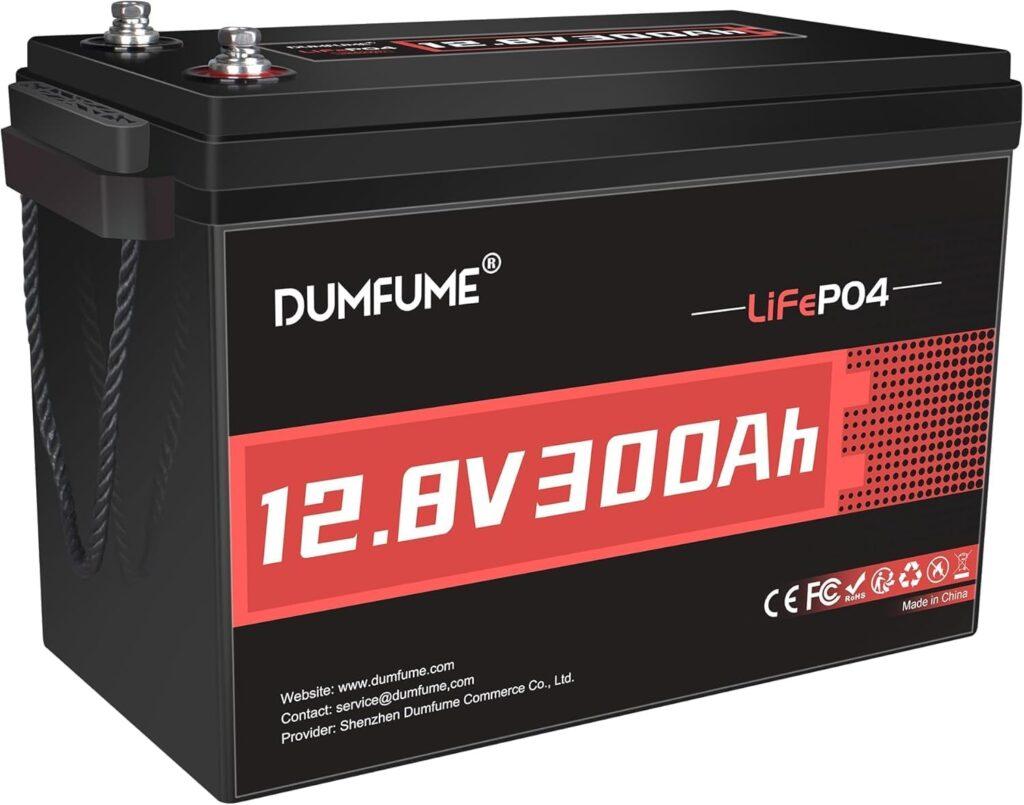
Key Specifications
- Capacity: 300Ah (3840Wh usable energy)
- Weight: Approx. 86.2 lbs
- Voltage: 12.8V
- BMS: 200A UL-certified with thermal cutoff
- Cycle Life: 4,000 to 15,000 cycles
If you’re looking for serious capacity without overspending, the Dumfume 12V 300Ah lithium battery checks all the boxes. It delivers up to 3840Wh of energy with a 200A BMS to handle powerful devices and high inverter loads—ideal for off-grid solar, RV boondocking, or even home backup.
You’ll appreciate how this battery handles extreme conditions. It includes thermal protection and auto shut-off for both hot and cold weather. That means fewer worries about damaging your system in changing climates, especially if you’re a traveler or seasonal camper.
Despite the lower price tag, this one doesn’t cut corners on safety. You get IP67 waterproofing, high-impact casing, and third-party certifications for peace of mind. If you want a reliable, entry-level LiFePO4 battery that won’t drain your wallet, this one delivers solid value.
Pros:
- Affordable for a 300Ah capacity battery
- 200A BMS with full protection and thermal cutoffs
- IP67 waterproof and durable ABS shell
- Compatible with solar, RV, and backup setups
- Expandable up to 20.48kWh for whole-home storage
Cons:
- Heavier than most 300Ah lithium batteries
- Lacks built-in Bluetooth or screen monitoring
- Dimensions are bulky, may not fit smaller RV trays
5. Best Value Option: Battle Born 100Ah 12V Lithium-Ion (LiFePO4)
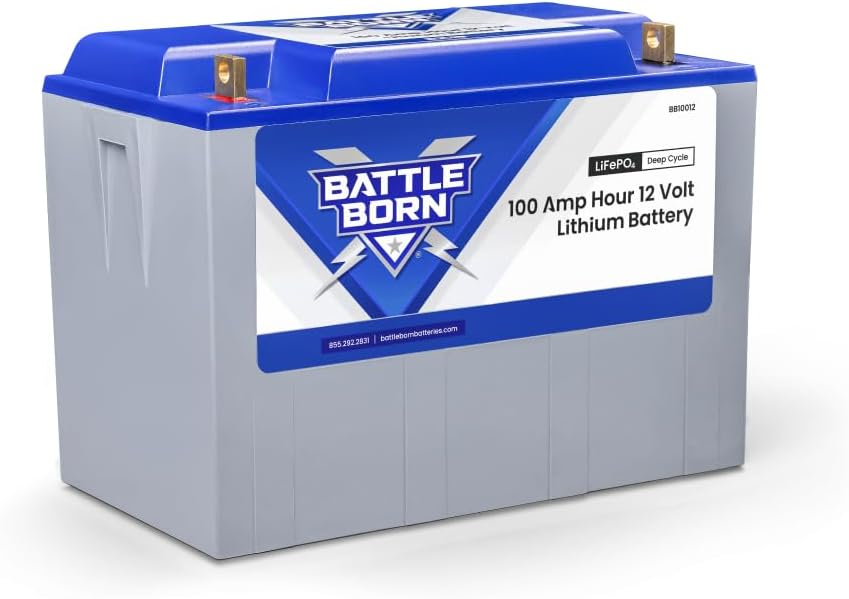
Key Specifications
- Capacity: 100Ah, 12V (1280Wh usable energy)
- Weight: 31 lbs
- Lifespan: 3,000–5,000 cycles
- BMS: Internal with high/low temp, voltage, and short circuit protection
- Connections: Supports series/parallel wiring
- Mounting: Any position
- Size: Drop-in Group 27 & 31 replacement
If you want a lighter RV lithium battery that still packs a punch, the Battle Born 100Ah 12V is a great choice. At just 31 pounds, it’s easy to carry, install, and mount anywhere in your RV, camper van, or boat. But don’t let the size fool you—it delivers serious performance with 100Ah of usable power and a built-in BMS to keep things safe.
What’s great about this battery is its plug-and-play design. It fits where a standard Group 27 or 31 battery would go, making upgrades from lead-acid super simple. You won’t need to adjust wiring or swap out chargers if you’re already running a 12V setup. Plus, it charges fast and holds steady voltage the whole way down, which is perfect for solar setups, fridges, or CPAP machines.
If you’re planning a multi-battery bank, this one’s ready. You can wire it in series or parallel for higher voltage or capacity, and its tough case makes it road-trip ready. While it doesn’t come with Bluetooth or heating, its reliability, weight savings, and 10-year warranty make it a favorite for RVers who want no-fuss lithium performance in a compact build.
Pros:
- Lightweight and compact, only 31 lbs
- Long lifespan with up to 5,000 deep cycles
- Drop-in fit for Group 27/31 battery compartments
- 10-year warranty with great brand support
Cons:
- No Bluetooth or app-based monitoring
- No built-in heating for cold-weather charging
- Higher cost per Ah compared to larger batteries
6. Best Compact Bluetooth Option: Wattcycle 12V 314Ah Mini LiFePO4 Lithium Battery
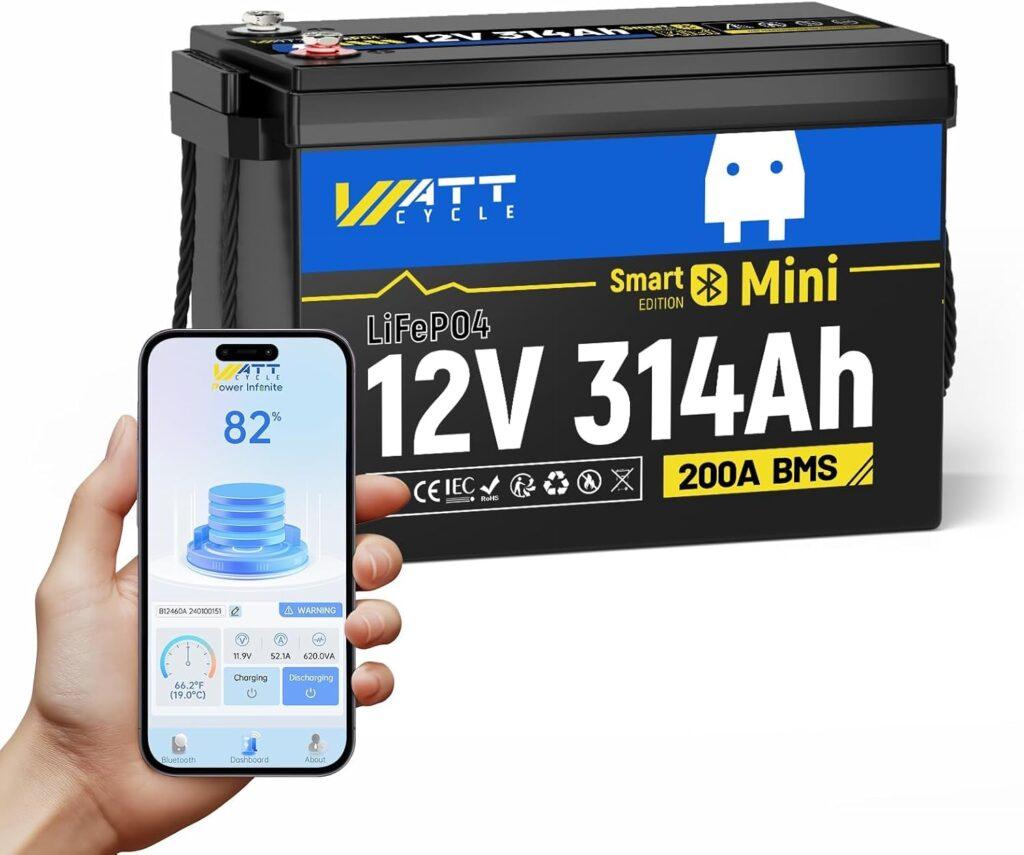
Key Specifications:
- Capacity: 314Ah (4.01kWh), 12V
- Weight: 59.5 lbs
- Dimensions: 15.04 x 6.93 x 7.36 in
- BMS: 200A with low-temp and overcurrent protection
- Bluetooth: 5.0, 300-ft range
- Cycle Life: Up to 15,000 cycles (DOD)
- Unique Features: Braided copper wiring, aluminum heat fins, full-aluminum internal skeleton
If you’re powering an RV setup with energy-hungry gear or a solar system that runs day and night, the Wattcycle 12V 314Ah Mini is built with you in mind. It gives you more usable energy than many 300Ah units without hogging space. You get 4.01kWh in a mini footprint — and the performance feels like it belongs in a much bigger battery.
One thing we really liked while testing was the upgraded internal structure. You’ve got braided copper wiring for better current flow, full aluminum internals for strength and zero swelling risk, and those cooling fins? They actually work. This thing runs cooler than most other units in this range, especially under 2000W+ loads.
Plus, the Bluetooth 5.0 app is stable, fast, and reaches farther than most apps we’ve tested — up to 300 feet. You can monitor your system right from the camper, the cabin, or even outside by the fire. Combine that with expandable 4S4P configuration and this battery becomes a serious candidate for RVers running solar, inverters, or full-time setups.
Pros:
- Huge 4.01kWh capacity in compact size
- Superior heat management and conductivity
- Real-time Bluetooth 5.0 monitoring
- Rugged, anti-swell aluminum frame
- Expandable for larger off-grid builds
Cons:
- On the heavier side for its class
- Premium design comes at a slightly higher cost
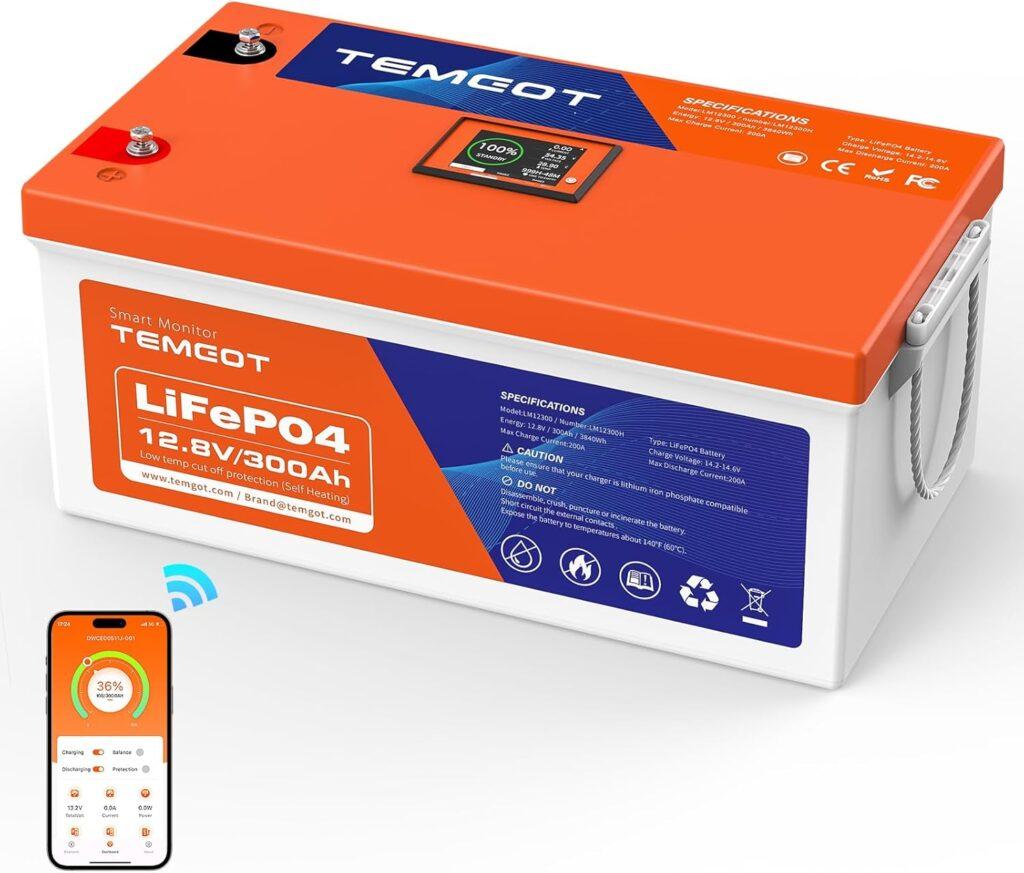
7. Best All-Weather Option: TEMGOT 12V 300Ah Self-Heating LiFePO4
Key Specifications
- Capacity: 300Ah, 12.8V (3840Wh usable energy)
- Weight: 64.92 lbs
- BMS: 200A smart BMS with full protection
- Self-Heating: Activates below 32°F, charges after reaching 41°F
- Monitoring: Built-in touch screen + Bluetooth App (iOS/Android)
- Cycle Life: 5,000+ deep cycles
If you’re camping in extreme weather or living off-grid year-round, the TEMGOT 12V 300Ah battery is a powerhouse built for all climates. It’s packed with advanced features like self-heating, a touchscreen for real-time data, and app-based Bluetooth monitoring that makes battery tracking effortless, even in the cold.
You don’t need to worry about charging in freezing temperatures. The self-heating system kicks in automatically at 32°F and ensures safe charging starts once the internal temperature hits 41°F. This is huge if you travel in winter or live in colder regions where most lithium batteries can fail to charge properly.
Its high 200A BMS and 300Ah capacity mean this battery can run your entire RV system, from appliances to inverters. You’re also getting 5,000+ cycles of stable power and a touchscreen right on the unit, no guesswork, no tools, just tap and check. For anyone who needs reliable lithium power in all seasons, this one nails it.
Pros:
- Built-in touchscreen plus Bluetooth app monitoring
- Self-heating ensures winter charging protection
- 300Ah high capacity with 3840Wh of energy
- 200A smart BMS with full safety controls
- Backed by 5-year warranty and customer service
Cons:
- Heavier than non-heating 300Ah models
- Higher upfront cost due to advanced features
- Can’t pair with non-heating batteries in parallel/series
What Is A 12V Lithium Battery For RV?
A 12V lithium battery for RV is a lightweight, rechargeable power source that delivers steady 12-volt DC power to run lights, appliances, fans, and other devices. Unlike lead-acid or AGM batteries, it charges faster, lasts longer, and provides nearly full usable capacity. Most RV lithium batteries use LiFePO4 (Lithium Iron Phosphate) chemistry, which is safer, more stable, and ideal for off-grid and solar-powered setups.
What “12 Volt” Means In RV Power Systems
Most RVs are built around 12V DC systems. That includes lighting, water pumps, control panels, and small appliances.
- Plug-and-play ready with standard RV wiring
- Steady voltage protects sensitive electronics
- Works with existing fuses and chargers
A 12V lithium battery easily replaces traditional options without needing rewiring or extra parts.
What Is LiFePO4?
LiFePO4 (Lithium Iron Phosphate) is the go-to chemistry for RV lithium batteries because it’s safe, reliable, and long-lasting.
- No fire risk even under stress or damage
- 3,000–5,000 cycles, or 5–10 years of use
- Safe deep discharges with 90–100% usable capacity
- No maintenance or water checks needed
- Cobalt-free and more stable than other lithium types
It’s the best mix of safety, performance, and long-term savings for RVers.
Recommended Guide: What are VRLA Batteries? (Benefits of Using AGM Batteries)
Why You Should Consider Upgrading to Lithium Batteries
Lithium batteries are a smart upgrade for RVs because they last longer, weigh less, charge faster, and let you use nearly all their power without damage. They outperform traditional lead-acid or AGM batteries in every way, especially for camping, boondocking, or solar setups.
Here’s what makes them a better choice for RV living:
- Longer Lifespan (3000–10,000 Cycles): A good lithium battery can last 10 years or more. That’s up to five times longer than a lead-acid or AGM battery. Great for full-time RVers or heavy solar users who cycle batteries daily.
- Lightweight and Compact: Lithium batteries weigh up to 50% less than comparable AGM models. This saves space and cuts down your RV’s overall weight, which can help with fuel efficiency.
- Maintenance-Free Operation: No need to check water levels, clean terminals, or deal with corrosion. Just plug it in and let it run.
- Deep Discharge Without Damage: You can safely use 90 to 100% of a lithium battery’s capacity without shortening its life. Lead-acid batteries can only give you about 50 to 60% before risking damage.
- Faster, More Efficient Charging: Lithium batteries accept high current without overheating or gassing. They charge quickly with solar, shore power, or a lithium-compatible charger.
- Consistent Voltage Output: They hold steady voltage until almost fully drained. That’s important for running sensitive gear like inverters, laptops, and medical equipment.
- Flexible Mounting (Any Position): Since there’s no liquid inside, you can mount a lithium battery on its side or even upside down. Perfect for tight spaces or van builds.
Understanding Discharge Rate
Discharge rate tells you how fast a battery delivers power to your RV. It’s measured in amps (A) or watts (W) and shows whether your battery can handle appliances like inverters, microwaves, or air conditioners without shutting down.
A 12V lithium battery usually lists two discharge ratings:
- Continuous discharge is the steady amount of current it can supply.
- Peak discharge is the short burst it can deliver for a few seconds, useful for startup surges.
For example, a 100Ah lithium RV battery with a 100A continuous and 200A peak discharge can safely power a 1200W load continuously and briefly run a 2400W spike.
Why does this matter? Different RV appliances pull different loads:
- Microwave or coffee maker: 800–1500W = 65–125A
- Water pump: 5–10A
- Roof AC: Up to 150A with startup surge
- Lights/fans: 1–5A
If your battery’s discharge rate is too low, it may trip the BMS (Battery Management System) or damage the cells.
This is especially important when using an inverter. For example, a 2000W inverter draws about 166A at 12V. If your battery supports only 100A continuous, it won’t be enough unless you wire two or more batteries in parallel or buy a model with higher output.
In short, matching your inverter and appliance needs with the battery’s discharge rate keeps your RV power system stable and safe. Always check both continuous and peak ratings before buying a 12V lithium battery for RV use.
Different Types of RV Batteries
RV batteries come in three types: flooded lead-acid, AGM, and lithium (LiFePO4). Flooded and AGM are cheaper but heavier, need maintenance, and offer less usable power. Lithium batteries cost more upfront but are lighter, last much longer, and give you nearly full capacity with no upkeep, making them the best choice for most RV owners.
Flooded Lead-Acid Batteries
These are the least expensive, but need regular maintenance like topping off water and cleaning terminals. They vent gas when charging and must be installed upright in a ventilated space. Only about 50% of their capacity is usable, and they typically last 2–3 years.
AGM Batteries (Absorbent Glass Mat)
AGM batteries are sealed, spill-proof, and vibration-resistant. They’re easier to maintain than flooded types and can be mounted in different positions. However, they still offer just 50–60% usable capacity and last about 3–5 years.
Lithium Batteries (LiFePO4)
Lithium Iron Phosphate (LiFePO4) batteries are lightweight, maintenance-free, and offer 90–100% usable capacity. They last 10+ years (3,000–5,000 cycles), hold a steady voltage, and recharge faster. With built-in BMS protection, they’re the top pick for off-grid use, solar systems, and full-time RV living.
How to Choose the Best Lithium Battery for RV Use
When choosing a 12V lithium battery for RV use, look for key features like amp-hour capacity, a built-in BMS, cold-weather protection, and smart monitoring options. These factors affect how much power you get, how safely the battery runs, and how well it fits your RV setup, especially if you’re boondocking, using solar, or camping in extreme temperatures.
Capacity in Amp-Hours (Ah)
Amp-hours tell you how much energy your battery can store. A 100Ah lithium battery gives you roughly 1,200 watt-hours (Wh) of usable power. For basic needs like lights, fans, and a fridge, 100Ah may be enough. But if you run an inverter, microwave, or AC, you’ll likely need 200Ah or more. Always estimate your daily power use to match the right size.
To figure out how much energy a battery holds, multiply amp-hours (Ah) by voltage (V).
For example:
100Ah × 12V = 1,200 watt-hours (Wh)
That means a 100Ah lithium battery stores about 1.2 kilowatt-hours of usable energy. Since lithium batteries let you use nearly all of that, it’s great for RVs running off-grid.
Want to know how long it will run your gear?
Use this: Battery Runtime (in hours) = Watt-hours ÷ Device Wattage
Example:
A fridge that uses 60 watts:
1,200Wh ÷ 60W = 20 hours of runtime (approximate)
This helps you size your battery based on what you plan to run.
BMS (Battery Management System) Features
The BMS is your battery’s safety net. It protects against overcharging, deep discharge, short circuits, overheating, and low temperatures. A good BMS also balances individual cells to keep everything running evenly. If your battery doesn’t list its BMS specs, skip it. Look for continuous/peak amp ratings and low-temp cutoffs.
Cold-Weather Protection
Lithium batteries don’t charge well below freezing. Some models include self-heating to safely warm the cells before charging. Others have a low-temperature cutoff to block charging until the battery is warm enough. If you camp in cold climates, heated lithium batteries or insulated battery boxes are worth it.
Smart Features & Bluetooth
Many newer lithium batteries come with Bluetooth apps or digital displays. These let you check the battery’s voltage, charge level, temperature, and more from your phone. This is handy for remote monitoring, especially with solar systems or enclosed installations.
Parallel/Series Capability
If you need more power or voltage, check whether the battery supports linking with others. Parallel connections increase capacity (Ah), while series connections increase voltage (24V or 48V setups). Most lithium RV batteries support 4 in parallel or series—check the spec sheet before wiring.
Battery Group Size
Battery group size refers to the battery’s physical dimensions. Common RV sizes are Group 24, 27, or 31. Before buying, measure your battery compartment and check the size listed by the manufacturer to make sure it fits snugly and safely.
Charging Cycle Life
A charging cycle is one full discharge and recharge. Most lithium RV batteries offer 3,000 to 5,000 cycles, while AGM and lead-acid may only last 300 to 800 cycles. That means lithium can easily last 5 to 10 years, even with frequent use. If you plan to camp often or go off-grid, this long cycle life saves money and reduces hassle over time.
Each charge and discharge is called one cycle. Lithium batteries usually last 3,000 to 5,000 cycles.
To estimate total energy over a battery’s lifetime:
Total Lifetime Energy = Battery Wh × Number of Cycles
So for a 100Ah 12V battery (1,200Wh) with 4,000 cycles:
1,200Wh × 4,000 = 4,800,000 watt-hours (or 4,800 kWh)
That’s a massive return compared to AGM batteries, which may only give you 400–800 cycles.
Warranty & Brand Reputation
A strong warranty is a sign the company stands behind its battery. Look for at least 5 years of coverage. Also, check customer reviews and real-world use cases. Trusted brands like Battle Born, LiTime, Redodo, and Weize often provide better support, build quality, and documentation. Avoid brands with vague specs or no customer service.
How To Install A Lithium Battery In Your RV (Step-By-Step)
Installing a lithium battery in your RV isn’t as complicated as it sounds. With the right tools and a few key checks, you can safely swap out an old lead-acid or AGM battery for a modern lithium one that performs better and lasts longer. Below is a step-by-step process to help you do it right.
What You’ll Need
Before starting, gather the following:
- A basic wrench set
- A multimeter
- A lithium-compatible charger or converter
- Safety gloves
- Optional: battery monitor or shunt
Step-By-Step Process
- Disconnect the old battery: Always remove the negative terminal first to avoid sparks.
- Inspect the battery tray: Make sure the new battery fits securely and doesn’t rattle.
- Secure the new lithium battery: Place it snugly in the tray, using brackets or padding if needed.
- Connect the terminals: This time, positive goes on first, then the negative.
- Install a fuse or battery isolator: Helps protect your system from overload or cross-charging.
- Power on and test: Use a multimeter to confirm voltage and test connected loads.
Converter & Charger Compatibility
Standard lead-acid chargers might not fully charge lithium batteries—or worse, could harm them. Lithium batteries need a different voltage profile to charge properly.
- Look for 3-stage or 4-stage lithium-compatible chargers.
- Many converters support bulk, absorption, and float modes, but lithium needs a higher bulk voltage (~14.4V) and no float or trickle stage.
Maintenance & Storage Tips for Lithium RV Batteries
Lithium RV batteries are low-maintenance, but a few smart habits can help them last longer and perform better. Store them correctly in the off-season, use the right charging methods, and avoid extreme conditions to get the most out of your investment.
Here’s how to take care of your 12V lithium battery for RV use:
- Store at Partial Charge: Keep your battery around 50% charged when storing it for weeks or months. Don’t leave it fully charged or completely empty.
- Keep It Cool and Dry: Store batteries in a shaded, dry place. Avoid freezing temperatures and direct sunlight, especially during off-season months.
- Disconnect When Not in Use: Unplug terminals or use a battery disconnect switch to prevent slow drain from parasitic loads like propane detectors or LED lights.
- Use a Lithium-Compatible Charger: Always use a charger designed for LiFePO4 batteries. Overcharging or trickle charging with a lead-acid charger can shorten battery life.
- Avoid Charging Below Freezing: Charging below 32°F can damage lithium cells unless your battery has a built-in heating function. Wait until it warms up or use a heated model.
- Charge Regularly During Use: If you’re actively using your RV, keep the battery topped off with solar, shore power, or alternator charging to avoid deep discharge cycles.
- Check BMS Status If Issues Arise: If the battery doesn’t charge or power your RV, check if the BMS (Battery Management System) has triggered a safety shutoff. A reset may be needed.
Following these tips can extend the life of your battery, prevent performance issues, and keep your power reliable on the road or in storage.
Final Verdict
If you’re ready to upgrade your RV power system, choosing the right lithium battery will seriously change how you travel. No more running out of juice mid-trip or stressing over cold starts—just clean, consistent power wherever the road takes you.
For the best overall performance, the LiTime 12V 230Ah Bluetooth LiFePO4 Battery is hard to beat. It delivers massive capacity, up to 230Ah, and is perfect for long off-grid stays. You get top-tier reliability without overcomplicating things, just strong, steady power for everything from fridges to solar setups.
Need something lightweight but still tough? The Battle Born 100Ah 12V Lithium-Ion (LiFePO4) is your go-to. At just 31 pounds, it’s a breeze to install, yet it still delivers thousands of cycles and top-grade safety features, ideal for smaller RVs or minimalist setups.
Worried about cold weather? The VATRER POWER 12.8V 300Ah Self-Heating LiFePO4 has built-in self-heating, so it charges even below freezing. Combined with Bluetooth monitoring and a rugged 200A BMS, it’s perfect for winter camping or mountain trips.
Whichever one you choose, you’re getting more than just a battery, you’re buying peace of mind, freedom, and power you can trust.
Related FAQs
Can I Use My Existing Charger for Lithium Batteries?
Only if it’s lithium-compatible. Older chargers may undercharge or damage lithium batteries by using incorrect voltage profiles.
Do Lithium Batteries Charge Faster Than AGM or Lead-Acid?
Yes, lithium batteries accept higher charging current and complete bulk charging faster, saving you time on the road.
How Long Does a 100Ah Lithium Battery Last in an RV?
It depends on your usage. For lights, fans, and a fridge, it can last 1–2 days. With proper care, the battery lifespan is 3,000–5,000 cycles.
Can Lithium RV Batteries Explode?
No. LiFePO4 batteries are thermally stable and rarely fail. With a good BMS, they’re even safer than traditional lead-acid batteries.
Are Bluetooth Lithium Batteries Worth It?
Yes, especially for solar and off-grid RV setups. You can check charge, voltage, and temperature right from your phone.
Can Lithium Batteries Be Used in Freezing Temperatures?
Only if they have low-temp cutoff or built-in heaters. Charging below 32°F without protection can permanently damage the cells.
Is It Safe to Mount Lithium Batteries Inside the RV?
Yes. Lithium batteries don’t release gas and are safe to mount inside, even under seats or in cabinets.
How Many Lithium Batteries Do I Need for Off-Grid RV Camping?
It depends on your daily power draw. Most off-grid campers use 200Ah to 400Ah, paired with a solar setup that can recharge that capacity.

Matt Riggins has spent years working with generators, solar panels, transfer switches, batteries, fuel setups, and circuit wiring. He’s the guy friends and neighbors call when the power goes out or something just won’t run right. From off-grid installs to fixing up old or new portable units, he’s been through it all. Alan doesn’t just talk theory, he’s out there solving real problems and helping people keep their systems running when it matters most.