If you’re looking for the best generators for emergency home backup, you want something that actually keeps life going when the lights go out. Whether it’s a sudden storm, a power grid failure, or an extended outage, the right generator gives you peace of mind knowing your fridge, lights, and essential devices stay on.
We tested models across different needs—from the powerful Westinghouse 12500 Watt and value-packed DuroMax XP13000EH, to the budget-friendly WEN DF475T Dual Fuel, compact Champion Power Equipment 4500-Watt, and the fully automatic Generac 7291 26kW standby unit. Each one delivers dependable power suited for different homes and budgets.
In this guide, we’ve tested how long they run, how loud they get, and how smoothly they handle varying loads—so you can confidently choose the generator that’ll keep your home powered through any emergency.
We’re reader-supported. When you buy through links on our site, we may earn an affiliate commission. As an Amazon Associate, we earn from qualifying purchases at no extra cost to you.
Best Generators for Emergency Home Backup: Our Top Picks
- Best Overall Option: Westinghouse 12500 Watt
- Best Budget-Friendly Option: WEN DF475T Dual Fuel
- Value for Money Option: DuroMax XP13000EH
- Portable Option: Champion Power Equipment 4500-Watt
- Emergency Standby Option: Generac 7291 26kW
1. Best Overall Option: Westinghouse 12500 Watt

Key Details:
- Power Output: 9,500 running watts and 12,500 peak watts on gasoline
- Fuel Type: Gasoline and propane
- Engine: 457cc 4-stroke OHV
- Runtime: Up to 12 hours at 25% load on gasoline
- Starting System: Remote, electric, and recoil start
The Westinghouse WGen9500DF is an excellent option for homeowners who need serious emergency backup power. With 9,500 running watts on gasoline, it can support several essential household appliances simultaneously. Its dual fuel capability also gives you flexibility when gasoline becomes difficult to find during storms.
What makes the Westinghouse WGen9500DF particularly useful is its 120/240V output and transfer switch compatibility. You can connect selected household circuits through a properly installed transfer switch. This makes powering refrigerators, sump pumps, lighting, and other essential equipment more convenient during extended outages.
We also like the remote electric start, especially when preparing for an unexpected blackout. The 6.6-gallon fuel tank provides up to 12 hours of runtime at 25% load. Furthermore, the VFT display tracks voltage, frequency, and operating hours, making maintenance easier to manage.
At around 211 pounds, this isn’t a generator you’ll want to move frequently. However, the included wheels and handle make occasional repositioning manageable. If you’re looking for a powerful home emergency generator with flexible fuel options and practical controls, this is our leading choice.
Pros:
- Strong 9,500W running output for multiple household appliances
- Dual fuel operation provides flexibility during fuel shortages
- Remote electric start and convenient digital monitoring
- Transfer switch-ready 120/240V outlets for home backup
Cons:
- Heavy construction makes frequent transportation less convenient
- Around 74 dBA operation may be noticeable in residential areas
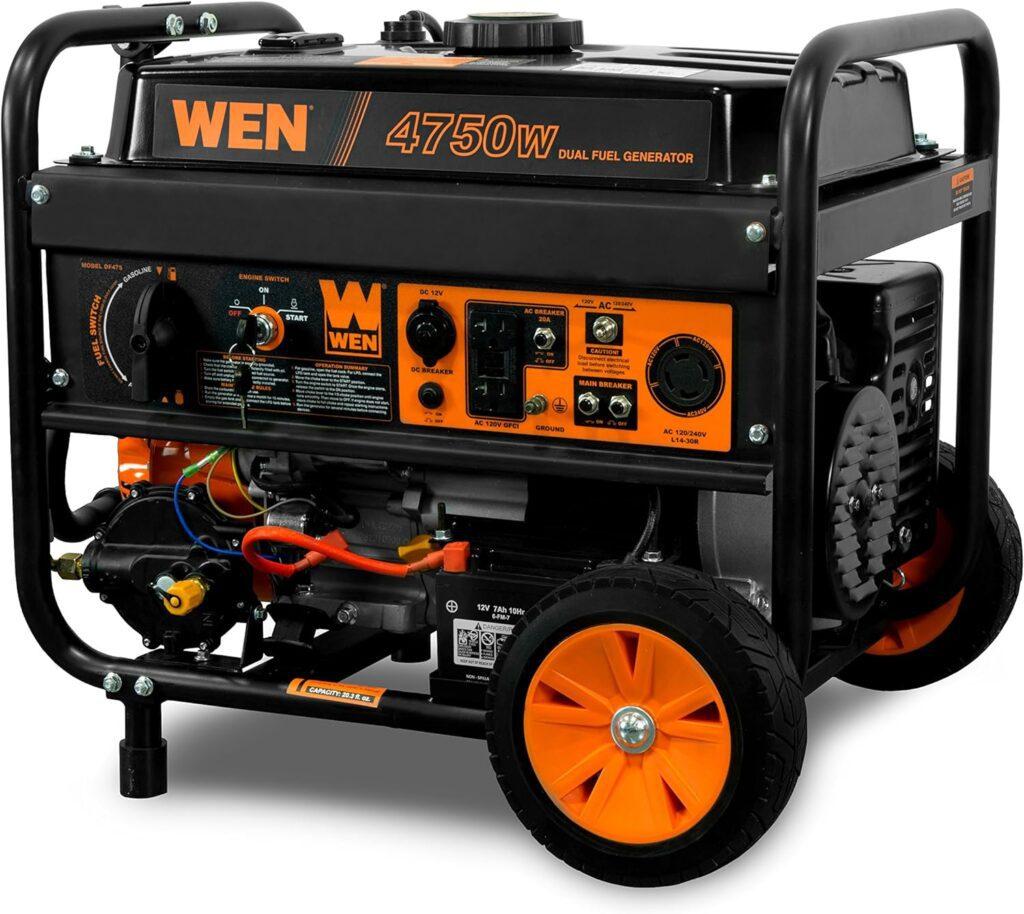
2. Best Budget-Friendly Option: WEN DF475T Dual Fuel
Key Details:
- Power Output: 3,800 running watts and 4,750 surge watts on gasoline
- Fuel Type: Gasoline and propane
- Engine: 224cc 4-stroke OHV
- Runtime: Up to 11 hours at half load on gasoline
- Starting System: Key-operated electric start
Not every household needs a massive generator during a power outage. The WEN DF475T makes more sense when your priority is keeping essential appliances running. Its 3,800 running watts on gasoline can support a refrigerator, lights, television, and other smaller household loads within its rated capacity.
One feature we particularly appreciate is the selectable 120V/240V output. When paired with a compatible transfer switch, the WEN DF475T can supply selected household circuits without relying entirely on extension cords. The electric start also makes operation straightforward, especially for homeowners who prefer a simpler setup.
During extended outages, fuel flexibility becomes important. You will find the ability to switch between gasoline and propane particularly useful when one fuel becomes unavailable. Moreover, the four-gallon gasoline tank offers up to 11 hours at half load, reducing frequent refueling.
Of course, this isn’t designed for running every major appliance simultaneously. Its output drops to 3,500 running watts when operating on propane. Still, for someone seeking a manageable portable generator for emergency home backup, the WEN DF475T offers a practical combination of useful features and dependable capacity.
Pros:
- Dual fuel capability supports gasoline and propane operation
- Selectable 120V/240V output with transfer switch-ready connection
- Electric start simplifies operation during unexpected outages
- Up to 11 hours of gasoline runtime at half load
Cons:
- Limited capacity for multiple high-wattage appliances
- Requires some effort to move despite its wheel kit
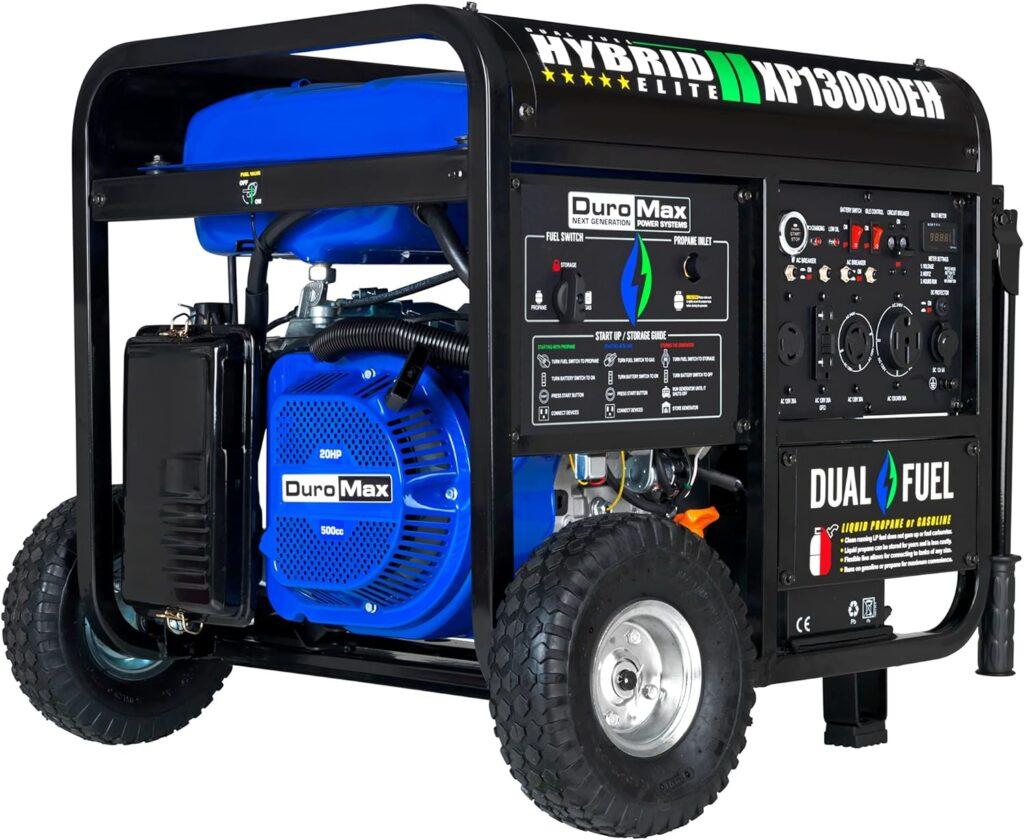
3. Value for Money Option: DuroMax XP13000EH
Key Details:
- Power Output: 10,500 running watts and 13,000 peak watts on gasoline
- Fuel Type: Gasoline and propane
- Engine: 500cc 4-stroke OHV
- Runtime: Up to 8 hours at 50% load on gasoline
- Starting System: Electric start with recoil backup
If you’re preparing for longer power outages, the DuroMax XP13000EH deserves serious consideration. This dual fuel portable generator delivers 10,500 running watts on gasoline, providing substantial capacity for household backup. It can support refrigerators, heating equipment, lighting, and other demanding appliances when their combined loads stay within its limits.
What stands out about the DuroMax XP13000EH is its combination of high output and versatile connections. The 120/240V capability and 50-amp outlet make it suitable for larger home backup arrangements. With a properly installed transfer switch, you can distribute power to selected circuits rather than connecting appliances individually.
We also appreciate the heavy-duty metal frame and straightforward electric start system. The 500cc engine provides substantial starting power for motor-driven appliances, including certain air conditioning systems. Additionally, low-oil shutdown, GFCI outlets, and a CO sensor shutdown system add useful protection during operation.
There are a couple of things worth considering before choosing this generator. At 234 pounds dry, it needs adequate storage space and a suitable outdoor operating location. However, for households requiring stronger emergency backup capacity without a permanently installed standby system, this is a compelling option.
Pros:
- Powerful 10,500W running capacity on gasoline
- Gasoline and propane operation improves fuel flexibility
- 120/240V output with a transfer switch-ready 50A outlet
- Heavy-duty construction with multiple electrical protection features
Cons:
- Heavy 234-pound dry weight requires careful positioning
- Around 74 dB noise output may be noticeable nearby
4. Portable Option: Champion Power Equipment 4500-Watt

Key Details:
- Power Output: 3,500 running watts and 4,500 starting watts on gasoline
- Fuel Type: Gasoline and propane
- Engine: 212cc 4-stroke OHV
- Runtime: Up to 14 hours at 25% load on gasoline
- Noise Level: 61 dBA at 23 feet
The Champion Power Equipment 4500-Watt inverter generator is particularly appealing when noise matters as much as backup power. Unlike larger open-frame generators, its enclosed inverter design offers quieter operation while supplying clean electricity. This makes it suitable for powering smaller household essentials, laptops, televisions, and other sensitive electronics.
What makes this Champion 4500-Watt inverter attractive is its balance between efficiency and practical output. It delivers 3,500 running watts on gasoline and 3,150 watts on propane. You can comfortably plan around several essential appliances, provided their combined running and starting requirements remain within the generator’s capacity.
We like the electric start system, Cold Start Technology, and Economy Mode. The inverter produces less than 3% total harmonic distortion, which is useful for sensitive electronics. Furthermore, its 61 dBA rating at 23 feet makes it noticeably quieter on paper than the larger open-frame generators in this selection.
One important consideration is its 120V-only electrical output. That makes it more suitable for individual appliances than household equipment requiring 240V. Still, if you want a quieter emergency generator for home use that can also serve an RV or campsite, this Champion model fits nicely.
Pros:
- Quiet 61 dBA operation at 23 feet
- Clean inverter electricity with less than 3% THD
- Dual fuel operation with convenient electric start
- Up to 14 hours of gasoline runtime at 25% load
Cons:
- 120V-only output limits compatibility with 240V appliances
- 3,500W running capacity requires careful appliance selection
5. Emergency Standby Option: Generac 7291 26kW

Key Details:
- Power Output: 26,000W on propane and 22,500W on natural gas
- Fuel Type: Natural gas and liquid propane
- Engine: 999cc Generac G-Force 1000 Series
- Transfer Switch: 200-amp automatic transfer switch
- Starting System: Automatic startup during utility outages
The Generac 7291 26kW Guardian is designed for homeowners who want permanent emergency backup power. Unlike portable generators requiring manual setup, this standby system automatically responds when utility electricity fails. Its substantial output makes it suitable for larger homes with multiple appliances, heating systems, and air conditioning loads.
A major advantage of the Generac 7291 is its included 200-amp automatic transfer switch. The system switches selected household loads to generator power without manual intervention. Furthermore, the 26kW propane rating provides substantial capacity, while natural gas operation delivers up to 22.5kW for homes with a suitable gas connection.
We particularly appreciate its Mobile Link Wi-Fi monitoring feature. You can check generator status and maintenance notifications remotely through a compatible smartphone or computer. The G-Force engine, enclosed aluminum housing, and Quiet-Test mode also make this a practical system for long-term residential backup.
Of course, this generator requires professional installation, proper fuel supply sizing, and a permanent outdoor location. Its 518-pound construction isn’t intended for relocation. However, if you want automatic whole-house backup without setting up a portable unit during every outage, the Generac 7291 is an excellent choice.
Pros:
- Automatic backup operation with a 200A transfer switch
- High output supports demanding household electrical loads
- Mobile Link Wi-Fi monitoring provides convenient remote status updates
- Enclosed construction and Quiet-Test mode support residential use
Cons:
- Requires professional installation and dedicated outdoor space
- Significant fuel consumption under sustained high electrical loads
Types of Generators Available for Home Backup Power Use
When the lights go out and the neighborhood plunges into darkness, a generator can be your shining beacon of reliability. Choosing the right type of generator for emergency home backup isn’t just about finding a power source; it’s about securing peace of mind. From the compact portables to robust standbys, each type has its role in safeguarding your home.
- Standby Generators: These are the stalwarts of home backup power, providing a seamless transition during power outages. Wired directly into your home’s electrical system, they kick in automatically when the power goes down. They’re ideal for sustaining critical appliances for extended periods, from refrigerators to heating systems.
- Portable Generators: For flexibility and convenience, portable generators are the go-to. Easy to move and set up, they can power essential items and are perfect for shorter outages or as a backup for outdoor activities.
- Inverter Generators: If you value efficiency and quieter operation, inverter generators are the way to go. They adjust the electrical characteristics to deliver only the amount of power you need, making them perfect for electronics and smaller appliances.
- Solar Generators: As the most eco-friendly option, solar generators harness sunlight to produce power. They’re quiet, emission-free, and increasingly popular for homeowners focused on sustainability.
As we consider the diversity in generator types, it’s clear that whether you’re looking to power a few essentials or maintain normalcy throughout your entire home, there’s a solution tailored to your needs.
How Do Generators for Emergency Home Backup Work?
Understanding how generators for emergency home backup operate can demystify much of their appeal. At their core, generators don’t create electricity; they convert fuel into electrical power, ready to jump into action when your main power source fails.
- Mechanism of Action: Generators kick in when a sensor detects a disruption in your main power supply. Within seconds, they begin converting stored gasoline, propane, or diesel into power. For homes equipped with solar generators, energy from the sun is converted and stored for such emergencies.
- Power Delivery: The electricity generated is then channeled into your home’s circuit panel, supplying power to appliances and lights just as your usual electricity would. The transition can be so seamless that sometimes the only indication of a power outage is the gentle hum of the generator outside.
- Safety Features: Modern generators are equipped with features that ensure safety and efficiency. These include automatic CO2 shutoffs to prevent dangerous emissions, overload protection to safeguard the generator and connected appliances, and quiet technology to minimize disturbance.
Moreover, the efficiency and adaptability of generators have seen significant improvements, making them indispensable in times of need. Whether it’s keeping the lights on, ensuring your home office remains operational, or powering medical equipment, generators provide a robust line of defense against the unpredictable. Understanding the basic principles of how these powerful machines work not only increases your appreciation for their functionality but also enhances your ability to make an informed choice about the right generator for your home.
Do You Need Generators for Emergency Home Backup?
Deciding whether you need a generator for emergency home backup hinges on understanding your unique circumstances. Emergencies often come without warning, making preparedness key to maintaining normalcy. Let’s delve into the considerations that help determine the necessity of a backup generator for your home.
Assessing Your Home’s Energy Needs During an Outage
Calculating your home’s energy requirements during an outage is the first step towards preparedness. Begin by listing all essential appliances and systems that need power, such as refrigerators, heating systems, and medical devices. Then, tally their wattage requirements. This sum will give you a clear baseline for the generator capacity needed to keep your household running smoothly.
Benefits of Having a Dedicated Emergency Generator
The advantages of installing a dedicated generator for emergency home backup are manifold. Safety is paramount—generators ensure that critical medical equipment and heating systems stay operational.
Furthermore, the convenience of uninterrupted power can significantly reduce the stress associated with outages. Economically, the potential cost savings from avoiding hotel stays, spoiled groceries, and damaged appliances can be substantial.
As we reflect on these points, the value of having a dedicated generator becomes unmistakably clear. It’s not just about keeping the lights on; it’s about ensuring safety, comfort, and economic stability during unpredictable times.
How to Choose the Best Generator for Emergency Home Backup Power
Navigating the purchase of a generator for emergency home backup power isn’t merely about making a transaction; it involves careful deliberation of your unique power needs and the specific attributes of different generators. Let’s dive into the essential considerations to guide you in selecting a reliable generator that aligns with your energy demands.
Assessing Your Power Requirements
Start by determining how much power you need to run your household during a blackout. Are you aiming to power just the essentials, or do you need a whole-house generator? Calculating the total wattage required by your critical appliances ensures you select a generator with enough capacity to handle your load without overstraining.
To calculate the total wattage required:
Total Wattage Required = Sum of (Running Wattage + Starting Wattage)
- Running Wattage is the continuous power an appliance uses while operating.
- Starting Wattage is the extra power needed to start motorized appliances, such as refrigerators or air conditioners.
Here’s an example of power usage during an outage:
- Add up the running wattage of all appliances you want to power.
- Identify the appliance with the highest starting wattage.
- Add the highest starting wattage to the total running wattage for the final total.
Let’s say you want to power the following appliances:
| Appliance | Running Wattage (W) | Starting Wattage (W) | Total (W) |
| Refrigerator | 700 | 1200 | 1200 |
| Microwave | 1000 | 0 | 1000 |
| Sump Pump | 750 | 1500 | 1500 |
| LED Lights (10 bulbs) | 100 | 0 | 100 |
| Wi-Fi Router | 50 | 0 | 50 |
| Phone Charger | 20 | 0 | 20 |
Step-by-step calculation:
1. Add the running wattages:
700 + 1000 + 750 + 100 + 50 + 20 = 2620 W.
2. Identify the highest starting wattage:
The sump pump has the highest starting wattage at 1500 W.
3. Add the highest starting wattage to the total running wattage:
2620 W + 1500 W = 4120 W.
Recommended Generator Size
Based on the calculation, you would need a generator with a minimum capacity of 4,500 to 5,000 watts to comfortably power these appliances, leaving a safe margin for additional needs.
Generator Sizing Table for Common Setups
| Setup | Approx. Wattage Needed | Recommended Generator Size |
| Basic Essentials (lights, fridge, Wi-Fi) | 2,000–3,000 W | 3,000–4,000 W |
| Medium Load (essentials + microwave, sump pump) | 4,000–5,000 W | 5,000–6,000 W |
| Large Load (whole house) | 7,500–12,000 W | 9,000–12,500 W |
Using this method ensures you choose the best generator for emergency home backup power that meets your household’s energy needs without overloading or underperforming.
Choosing the Right Fuel Type
The choice of fuel is crucial in selecting the right home backup generator. Gasoline, diesel, propane, and dual-fuel generators each offer advantages depending on availability, storage life, and cost-effectiveness. For instance, while gasoline might be readily available, propane and diesel are more stable for long-term storage, making them excellent choices for emergency power generation.
Deciding Between Portable and Standby Generators
Consider whether a portable generator or a standby generator better suits your needs. Portable generators for home backup are flexible and can be used in various locations, but they require manual start-up and monitoring. On the other hand, standby generators for emergency home backup offer the convenience of automatic operation and immediate response during a power outage.
Evaluating Noise Levels
Noise is a significant factor, especially in residential areas. Look for quiet generators for home use that operate around 60 dB, which is comparable to a normal conversation. This feature is particularly important if noise regulations are strict in your locality or you prefer minimizing disruption.
Examining Starting Mechanisms
Ease of operation is another important consideration. Generators with an electric start provide the utmost convenience, particularly those that can be activated remotely via a panel or a mobile app. This feature is invaluable during inclement weather conditions or when physical interaction with the unit is impractical.
Analyzing Run Time and Fuel Efficiency
Efficiency and run time dictate how often you’ll need to refuel your generator during extended outages. Opt for models that offer long run times at moderate loads to minimize refueling frequency. Fuel-efficient generators not only save on operational costs but also ensure continuous power without frequent maintenance interruptions.
Prioritizing Safety Features
Safety cannot be overlooked when choosing a generator for emergency home backup. Features such as carbon monoxide detectors, automatic shut-off systems for low oil levels, and circuit protection not only safeguard the generator but also protect your home and family from potential hazards.
Ensuring Compatibility with Transfer Switches
For seamless integration into your home’s electrical system, ensure that the generator is compatible with a transfer switch. This setup is crucial for home standby generators, as it automates the transition from the main power supply to the generator during outages, enhancing convenience and safety.
Considering Maintenance and Durability
Lastly, evaluate the generator’s build quality and ease of maintenance. Durable generators with robust engines and easily accessible maintenance features can significantly extend the lifespan of the unit while ensuring reliable operation during crucial times.
Professional Installation vs. DIY: What You Need to Know
When it comes to setting up a generator for emergency home backup, the debate between professional installation and DIY projects is crucial. While DIY appeals to the hands-on homeowner, understanding the intricacies of safety and regulations is essential. Let’s explore what you need to know to make an informed decision.
- Safety Considerations: Installing a generator involves electrical and fuel-related tasks that pose significant safety risks. Proper grounding, fuel line connections, and ventilation are critical to prevent fires, explosions, and carbon monoxide poisoning.
- Regulatory Compliance: Local codes and regulations often dictate specifics regarding generator installation. These may include placement restrictions, noise ordinances, and emissions standards that must be adhered to.
- When to Hire a Professional: If the installation process seems daunting or if your local regulations require professional certification, hiring a skilled technician is advisable. Professionals ensure that your generator is installed safely and in compliance with all local codes, providing peace of mind.
Considering these points, opting for professional installation can often be the safer and more compliant choice, especially for those unfamiliar with the technical demands of generator setup.
Routine Maintenance to Ensure Reliability
The reliability of your generator for emergency home backup heavily relies on consistent maintenance. A well-maintained generator is ready at a moment’s notice, crucial during unexpected power outages. Here’s a straightforward maintenance checklist and schedule to keep your generator in prime condition.
Maintenance Checklist:
- Regular Engine Checks: Ensure oil levels are sufficient, and air filters are clean.
- Fuel System: Regularly inspect for leaks and ensure fuel is fresh since old fuel can cause issues.
- Battery Inspection: Check battery charge and clean connections to prevent starting issues.
Maintenance Schedule:
- Weekly: Run the generator for at least 30 minutes to charge the battery and check for any operational issues.
- Monthly: Change oil if in frequent use, and inspect fuel and air filters.
- Annually: Have a professional service check to handle more complex systems like spark plugs and timing adjustments.
Adhering to this schedule not only prolongs the life of your generator but also ensures it’s ready when you truly need it. Remember, regular maintenance is the key to dependable generator performance during emergencies.
Safety Precautions for Using Generators for Emergency Home Backup
When deploying generators for emergency home backup, safety must be your top priority. It’s crucial to adhere to these precautions to protect your home and family. Make sure your generator is always placed outside, far from windows and doors, to prevent carbon monoxide from creeping indoors. Also, using the right power cords and keeping the generator dry and grounded protects against electrical hazards. Following these safety steps ensures that when you need your generator the most, it runs safely and efficiently.
Cost Analysis of Generators for Emergency Home Backup
Understanding the costs associated with generators for emergency home backup is essential for any homeowner considering this significant investment. This analysis helps balance the upfront expenditure against the potential long-term economic benefits.
Initial Investment vs. Long-Term Benefits
Investing in a generator involves upfront costs but the long-term benefits can be substantial. A reliable generator not only keeps the lights on but may also reduce your home insurance premiums by lowering the risk of damage during power outages.
Additionally, it helps avoid costs related to spoiled food, disrupted work, and even temporary lodging expenses during prolonged blackouts. Essentially, a generator acts as a financial safety net, providing peace of mind and financial benefits beyond just emergency power.
Considering Fuel Types and Their Costs Over Time
The choice of fuel for your generator—be it gasoline, diesel, propane, or natural gas—can significantly impact both initial and ongoing expenses. While gasoline generators might seem cost-effective at first, propane and natural gas units often offer greater efficiency and have a longer shelf life, which can translate into savings over time.
Moreover, these fuels are typically more stable in pricing and availability, which adds an extra layer of reliability and cost predictability to your emergency preparedness plans.
Selecting the right generator, therefore, involves a careful evaluation of not just the purchase price, but also the long-term savings and operational benefits it brings.
Enhancing Your Home’s Energy Resilience
Boosting your home’s energy resilience is a proactive approach to ensure continuous power during outages, merging sustainability with reliability. By adopting advanced power solutions, you not only secure your energy needs but also contribute to a more sustainable future. Let’s explore how you can transform your generator setup into a robust and efficient energy system.
Integrating Generators with Renewable Energy Systems
Integrating generators with renewable energy sources like solar panels or wind turbines is an excellent strategy for achieving greater energy independence. This hybrid approach allows you to capitalize on renewable energy during sunny or windy days, storing excess power for later use.
When renewable sources aren’t enough, your generator steps in seamlessly, extending the life of stored fuel and minimizing your carbon footprint. Automated systems manage the transition between power sources smoothly, ensuring you always have electricity without any hassle.
Smart Generators for Emergency Backup Power Management in Home
Enter the era of smart generators, where convenience meets efficiency. These advanced systems come equipped with technology designed to streamline energy management. With features that allow for remote monitoring and control, you can manage your generator directly from your smartphone.
This capability means you can adjust settings, track energy usage, and receive maintenance alerts all in real-time, ensuring your generator is always running at peak efficiency. It’s not just about having backup power; it’s about having smart backup power that integrates seamlessly into your digital lifestyle.
Addressing Common Concerns About Generators for Home Backup
Generators are indispensable for ensuring power during outages, but they come with challenges that need careful consideration. Let’s address some common concerns associated with home generators to help you maximize their benefits without compromising your living space or comfort.
Dealing with Noise and Space Constraints
The issue of noise and the space a generator occupies are significant considerations for any homeowner. Thanks to technological advancements, solutions are at hand. Modern generators are designed to be more compact, providing substantial power output without taking up too much space—ideal for smaller properties or urban settings. Soundproof enclosures can also be a game-changer, significantly reducing operational noise to ensure your home remains a peaceful sanctuary.
Fuel Availability and Storage During Emergencies
Proper planning for fuel storage and availability is a cornerstone of effective emergency preparedness. Ensuring you have an adequate supply of fuel, safely stored and ready for use, is crucial. Consider diversifying your fuel options with multi-fuel generators that can run on gasoline, propane, or diesel.
This flexibility can be invaluable during widespread outages when certain fuel types may be harder to procure. Additionally, using fuel stabilizers can extend the life of your fuel, ensuring that it remains viable for when you need it most.
These enhancements and considerations are not just about powering through an outage; they’re about doing so efficiently, sustainably, and with minimal disruption to your daily life. By addressing these key aspects, you can truly optimize your generator for emergency home backup and enjoy peace of mind knowing you’re well-prepared for any situation.
Wrapping It Up!
IIt’s clear that choosing the right generator is not just about preparing for power outages—it’s about keeping your home safe, functional, and comfortable, no matter what life throws your way. A reliable generator, whether it’s an emergency generator for home or a portable emergency generator, stands ready to ensure that essential appliances, medical devices, and other necessities continue to operate seamlessly during a crisis.
Moreover, understanding the range of options available—from robust standby generators to versatile portable models—helps you tailor your choice to fit your specific needs. For many, investing in a dependable emergency backup generator or a home emergency generator can mean the difference between merely enduring a power outage and thriving through one. By exploring options like renewable energy integration or smart generator technology, you can not only enhance efficiency but also reduce costs and your ecological footprint.
The peace of mind that comes from having a generator for emergency home use cannot be overstated. It’s not just about keeping the lights on—it’s about protecting your family’s safety and comfort while avoiding the financial strains caused by unexpected outages.
In the end, choosing the right generator is about more than convenience; it’s about creating a resilient future for your home and loved ones. It’s a decision that provides both immediate comfort and long-term security, making it an investment that truly matters.
Related FAQs
What Generator Capacity Is Necessary for a Typical Home?
Assess the total wattage of essential appliances to determine the generator size that meets your needs during an outage.
Is Self-Installation of a Home Generator Advisable?
It’s possible for those with technical skills, but professional installation is advised for safety and to meet regulatory standards.
How Frequently Should I Operate My Generator for Optimal Performance?
Regularly running your generator for about 30 minutes each month is recommended to keep it in prime condition.
Which Fuel Type is Most Efficient for Home Backup Generators?
The efficiency varies, but propane and natural gas are popular due to their reliability and lower maintenance.
Can Portable Generators Handle the Power Needs of an Entire Home?
While portable generators are useful for limited applications, standby generators are typically needed for comprehensive home backup.

Matt Riggins has spent years working with generators, solar panels, transfer switches, batteries, fuel setups, and circuit wiring. He’s the guy friends and neighbors call when the power goes out or something just won’t run right. From off-grid installs to fixing up old or new portable units, he’s been through it all. Alan doesn’t just talk theory, he’s out there solving real problems and helping people keep their systems running when it matters most.