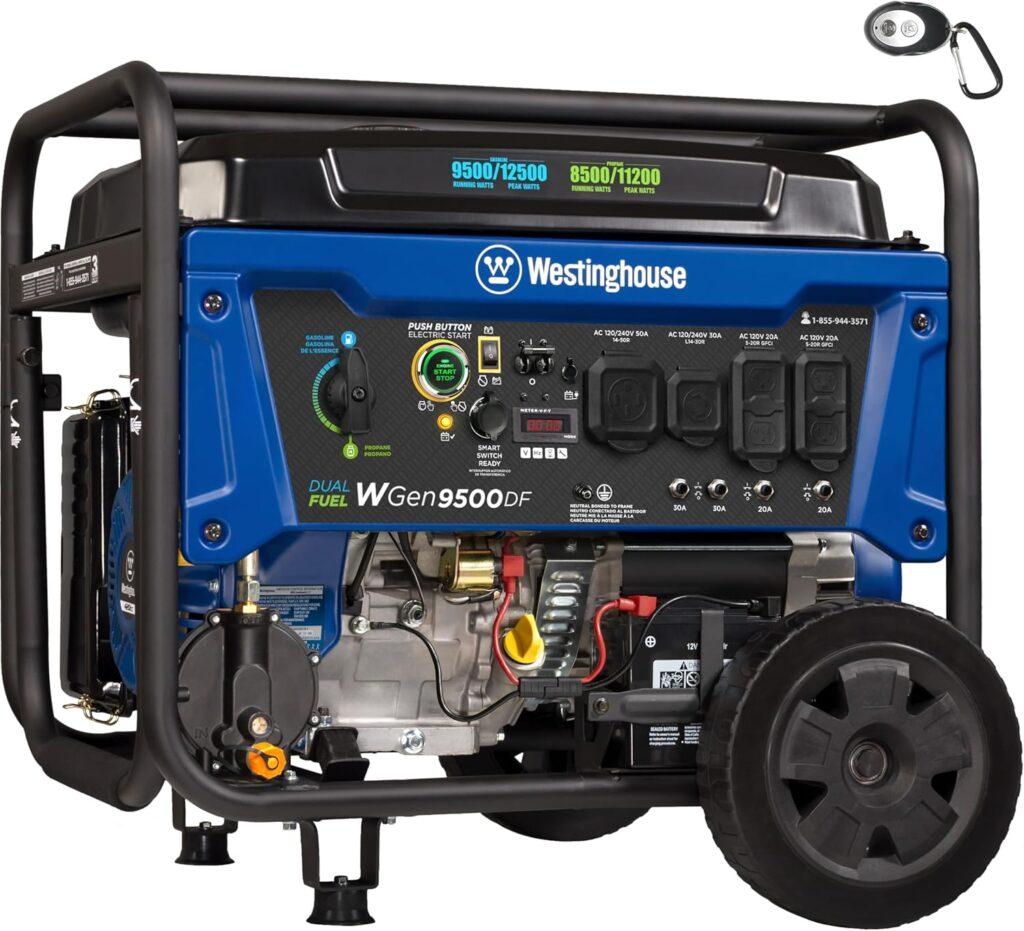
If you’re preparing your home for storm season or frequent power outages, the Westinghouse 12500 Watt Dual Fuel Home Backup Portable Generator (WGen9500DF) is likely already on your radar. With 9500 running watts on gasoline and 12500 peak watts, it sits right in that sweet spot for homeowners who want serious backup power without stepping into permanent standby generator territory.
What makes this model especially appealing is flexibility. You can run it on gasoline or propane, connect it to a transfer switch, and even start it remotely using the included key fob. That means less hassle when the lights go out and more control over how you manage fuel during emergencies.
In this review, we’ll break down exactly how the WGen9500DF performs in real-world home backup scenarios, what kind of appliances it can realistically handle, and whether it offers the long-term reliability and value most homeowners are looking for in 2026.
We’re reader-supported. When you buy through links on our site, we may earn an affiliate commission. As an Amazon Associate, we earn from qualifying purchases at no extra cost to you.
Quick Summary: Is the Westinghouse WGen9500DF Worth It?
Yes, for most homeowners needing high-output portable backup power, it absolutely is. The WGen9500DF delivers strong surge capacity, solid runtime, and practical home integration options that make it far more than just a jobsite generator.
With 9500 running watts on gasoline and 8500 running watts on propane, it can handle refrigerators, sump pumps, well pumps, microwaves, and even central air in some cases. The inclusion of both a 30A transfer switch outlet and a 50A outlet makes it versatile for different home setups and even RV use.
It’s not quiet like an inverter generator, and at 210 pounds it’s not lightweight. But in exchange, you get raw power, dual fuel capability, and a proven 457cc engine backed by a 3-year warranty.
If your priority is dependable whole-home backup during outages and you want fuel flexibility, this generator checks a lot of important boxes.
Pros of the Westinghouse WGen9500DF
This generator covers a lot of ground for homeowners who need serious backup capacity. Here’s what stands out most:
- 9500 running watts and 12500 peak watts on gasoline provide strong whole-home support
- Dual fuel capability allows operation on gasoline or propane
- Remote electric start with key fob makes startup simple during emergencies
- Transfer switch ready with L14-30R 30A outlet
- 120/240V 14-50R 50A outlet supports larger home panels and 50A RVs
- Up to 12 hours of runtime on a 6.6-gallon tank at moderate load
- Automatic Voltage Regulation helps maintain stable output
- Digital VFT display shows voltage, frequency, and lifetime hours
Cons of the Westinghouse WGen9500DF
While it’s powerful and versatile, there are a few practical trade-offs to consider:
- Heavy at 210 pounds, making it difficult to move solo
- Open-frame design means higher noise compared to inverter models
- Not inverter-clean power, so it may not be ideal for ultra-sensitive electronics without protection
- Large footprint requires dedicated storage space
- Fuel consumption increases noticeably under heavy loads
Westinghouse WGen9500DF 12500 Watt Dual Fuel Home Backup Portable Generator Specs at a Glance
Featured Snippet:
The Westinghouse WGen9500DF delivers 9500 running watts and 12500 peak watts on gasoline, supports dual fuel operation with propane, features remote electric start, a 457cc 4-stroke engine, 6.6-gallon fuel tank, up to 12 hours runtime, and includes 30A and 50A transfer switch-ready outlets for home backup use.
| Specification | Details |
| Model Name | WGen9500DF |
| Brand | Westinghouse |
| Starting Watts (Gasoline) | 12500 Watts |
| Running Watts (Gasoline) | 9500 Watts |
| Starting Watts (Propane) | 11200 Watts |
| Running Watts (Propane) | 8500 Watts |
| Engine Type | 457cc 4-Stroke OHV |
| Fuel Type | Gasoline, Propane |
| Fuel Tank Capacity | 6.6 Gallons |
| Runtime | Up to 12 Hours |
| Start Types | Remote Start, Electric Start, Recoil Start |
| Voltage | 120/240 Volts |
| Frequency | 60 Hz |
| Current Rating | 50 Amps |
| Outlets | 2x 120V 5–20R GFCI, 1x L14-30R 30A, 1x 14-50R 50A |
| Voltage Regulation | Automatic Voltage Regulation (AVR) |
| Display | Digital VFT (Voltage, Frequency, Lifetime Hours) |
| Total Power Outlets | 6 |
| Item Weight | 210 Pounds |
| Dimensions | 27.2 x 26.1 x 26.5 inches |
| Compliance | EPA Compliant, CARB Compliant Version Available |
| Warranty | 3-Year Limited Service, Labor, and Parts Coverage |
| Customer Rating | 4.7 out of 5 (27,000+ reviews) |
Real-World Performance Testing
The Westinghouse WGen9500DF is designed for homeowners who need more than basic emergency power. With 9500 running watts on gasoline, it has enough capacity to keep several essential appliances operating during an outage.
But can it handle larger household loads, and how much performance do you lose when switching to propane? Let’s look at its rated capabilities and practical home backup scenarios rather than claiming unverified hands-on test results.
Whole-Home Load Handling
The biggest advantage of the WGen9500DF is its ability to power multiple household appliances simultaneously. With 9500 running watts and 12500 starting watts on gasoline, it can support refrigerators, freezers, lighting, microwaves, sump pumps, and other essential equipment.
For example, a refrigerator, freezer, Wi-Fi router, television, and several LED lights would typically consume only a fraction of its available running power. That leaves room for additional appliances, provided their combined electrical demand stays within the generator’s limits.
What about central air conditioning? The WGen9500DF can support some central AC systems, particularly those equipped with compatible soft-start devices. However, larger units may exceed its starting capacity.
The important thing is to calculate both running and starting watts. Just because a generator produces 12500 peak watts doesn’t mean it can continuously supply that much electricity.
For most households prioritizing essential circuits instead of every appliance, the WGen9500DF offers substantial backup capacity.
Dual Fuel Performance: Gas vs Propane
One reason the Westinghouse WGen9500DF dual fuel generator appeals to homeowners is its flexibility during extended outages. You can operate it on gasoline or propane, depending on your available fuel supply.
Gasoline delivers the strongest performance, providing 9500 running watts and 12500 peak watts. This makes it the better choice when powering several demanding appliances simultaneously.
Propane reduces output to 8500 running watts and 11200 peak watts. That’s approximately 11% less continuous power, but still enough for many essential home backup applications.
Propane also offers a practical storage advantage. It doesn’t degrade in storage like gasoline, making properly stored propane tanks useful for emergency preparedness.
If maximum power is your priority, choose gasoline. If convenient fuel storage matters more, propane is an excellent alternative.
Transfer Switch Compatibility
The WGen9500DF is transfer switch ready, making it especially useful for homeowners planning a dedicated backup power system.
Its 120/240V L14-30R outlet supports a compatible 30A transfer switch. However, this connection limits power delivery to 7200 watts at 240V, even though the generator can produce more.
The larger 120/240V 14-50R outlet supports compatible 50A connections, allowing access to more of the generator’s available output. Actual power remains limited by the generator’s rated wattage.
This matters when powering several home circuits or operating larger 240V appliances.
You’ll need a properly installed transfer switch or approved interlock system. A licensed electrician should verify the connection, grounding arrangement, and circuit compatibility before use.
Voltage Regulation and Electronics Safety
The Westinghouse WGen9500DF features Automatic Voltage Regulation (AVR), which helps maintain consistent voltage as electrical loads change.
This is useful when operating refrigerators, pumps, fans, and other appliances that frequently cycle on and off.
However, there’s an important limitation. The WGen9500DF is a conventional generator, not an inverter model. Its specified total harmonic distortion can reach 23%, making it less suitable for equipment requiring very clean electrical power.
Many household appliances can operate on conventional generator power, but compatibility with sensitive electronics isn’t guaranteed.
For expensive computers, specialized electronics, or equipment requiring low-distortion power, a suitable online UPS or inverter generator may be a better option. A basic surge protector alone doesn’t correct harmonic distortion.
Cold Start and Remote Start Performance
Starting a generator during a storm shouldn’t become another headache. Fortunately, the WGen9500DF provides three starting options: remote electric start, push-button electric start, and manual recoil start.
The included key fob allows convenient remote starting after the generator has been safely positioned outdoors and its surroundings checked. This is particularly helpful during cold or rainy weather.
The electric starter removes the effort of repeatedly pulling a recoil cord. If the battery loses its charge, the manual starter provides a useful alternative.
However, starting reliability still depends on proper maintenance, battery condition, fuel quality, and temperature. Checking these before storm season is much better than discovering a problem during an outage.
Build Quality and Design
The Westinghouse WGen9500DF isn’t designed to be compact or lightweight. It’s a heavy-duty open-frame portable generator built around a large engine, sturdy frame, and practical home backup features.
Engine and Frame Construction
At its core is a 457cc four-stroke OHV engine with a cast iron cylinder sleeve. This construction is designed to withstand regular operation and reduce engine wear when properly maintained.
The steel frame surrounds the main components, providing protection during transportation and storage.
The generator also features a 6.6-gallon fuel tank, covered electrical outlets, and a digital hour meter that helps homeowners track maintenance intervals.
With a three-year limited residential warranty, the WGen9500DF offers additional reassurance for buyers planning to keep their generator for years.
Portability for a 210-Pound Generator
At approximately 210 pounds, the WGen9500DF is considerably heavier than smaller portable inverter generators.
Fortunately, its never-flat wheels and folding handle make moving it across a driveway or other firm, level surfaces more manageable.
Uneven ground, stairs, and loading it into a vehicle are different situations. You’ll likely appreciate having another person help.
Its dimensions of 27.2 x 26.1 x 26.5 inches also mean you’ll need adequate storage space.
For homeowners who occasionally move their generator between storage and a designated outdoor operating location, the design makes sense. Frequent transportation is less convenient.
Control Panel and Outlets Overview
The WGen9500DF provides several connection options for household appliances, RVs, and home backup electrical systems. Its control panel also places the main operating controls and monitoring features within easy reach.
- Four 120V household receptacles: Two GFCI-protected duplex 5-20R outlets accommodate standard appliances and extension cords.
- 30A transfer switch outlet: The 120/240V L14-30R connection supports compatible home backup transfer switches.
- 50A power outlet: The 120/240V 14-50R receptacle supports compatible 50A RV and home backup connections.
- Digital VFT display: Shows output voltage, frequency, and accumulated operating hours.
- Remote and electric start controls: Provide convenient starting options without relying entirely on the recoil starter.
- Fuel selector and gauge: Simplify fuel selection and help monitor the remaining gasoline supply.
- Circuit breakers and outlet covers: Provide overload protection and help protect unused receptacles.
The 30A and 50A outlets make this generator particularly attractive for homeowners who want a properly installed connection to their electrical panel.
Runtime and Fuel Efficiency
How long will the Westinghouse WGen9500DF run during a power outage? With its 6.6-gallon gasoline tank, Westinghouse specifies approximately 12 hours at 25% load and 8 hours at 50% load.
That’s useful for overnight backup, especially when you’re only running essential appliances. However, fuel consumption increases as more electrical demand is placed on the engine.
On propane, the generator offers approximately 7 hours at 50% load using a 20-pound tank. Actual runtime depends on the load, available propane, and operating conditions.
For longer outages, keeping your electrical demand reasonable can reduce refueling frequency. Turning off unnecessary appliances also leaves more starting capacity available for refrigerators, pumps, and other motor-driven equipment.
Noise Level Expectations
If you’re wondering whether the Westinghouse WGen9500DF is quiet, the answer is no. Its large 457cc engine and open-frame construction generate noticeable operating noise. Westinghouse lists a noise level of approximately 74 dBA.
- Noticeable engine sound: Expect a steady mechanical noise while the generator operates.
- Louder under demanding loads: Engine and exhaust noise can become more noticeable as electrical demand increases.
- Less suitable for quiet camping: Enclosed inverter generators are generally preferable when low noise is a priority.
- Outdoor positioning matters: Proper placement can reduce how much operating noise reaches living areas, while maintaining necessary safety distances.
For emergency home backup, the noise may be an acceptable compromise for the available power. However, buyers with noise-sensitive neighbors should consider it before purchasing.
Safety Features of the Westinghouse WGen9500DF
Safety matters just as much as power output, especially when operating a gasoline or propane generator during an emergency.
The WGen9500DF includes several protective features designed to help prevent equipment damage and electrical problems. However, its standard WGen9500DF version does not include an automatic carbon monoxide shutoff sensor.
- Automatic low-oil shutdown: Stops the engine when oil levels become dangerously low, helping protect internal components.
- Overload protection: Circuit breakers help protect the generator when electrical demand exceeds safe limits.
- GFCI household outlets: Help reduce electric shock risks when using the protected 120V receptacles.
- Covered receptacles: Rubber outlet covers provide additional protection when connections aren’t being used.
- Carbon monoxide precautions: Always operate the generator outdoors, at least 20 feet from the home, with exhaust directed away from doors, windows, and vents.
- Home electrical connection: Use a professionally installed transfer switch or approved interlock system. Never backfeed electricity through a household wall outlet.
- Safe refueling: Shut down the generator and allow the engine to cool before adding gasoline.
Install working carbon monoxide alarms throughout your home, including near sleeping areas. Never operate this generator inside a garage, basement, enclosed porch, or shed, even with doors open.
If automatic CO shutoff is important to you, consider the separate WGen9500DFc version, which includes a carbon monoxide sensor.
What We Liked Most About the WGen9500DF
What makes the Westinghouse WGen9500DF appealing isn’t simply its 12500-watt peak output. It’s the combination of high running power, flexible fuel options, and home backup connections.
Many homeowners don’t want an expensive permanent standby installation. They want something capable of keeping their refrigerator, water pump, lights, and other essentials running when utility power fails.
That’s where this generator makes a strong case for itself. Several features stand out:
- Generous backup capacity: Its 9500 running watts on gasoline provide room for multiple essential appliances and selected larger loads.
- Flexible fuel choices: Gasoline delivers maximum output, while propane provides a convenient alternative when gasoline isn’t available.
- Useful home connection options: Both 30A and 50A outlets offer flexibility for compatible transfer switch installations.
- Convenient starting system: Remote electric start, push-button start, and recoil backup provide three ways to get the engine running.
- Practical runtime: The 6.6-gallon tank supports extended operation when electrical demand is kept under control.
- Helpful maintenance monitoring: The digital VFT meter makes tracking operating hours and planning routine service easier.
The WGen9500DF offers a compelling combination of features for buyers who prioritize power and emergency preparedness over compactness and quiet operation.
Where the WGen9500DF Could Be Better
The Westinghouse WGen9500DF has plenty of strengths, but there are some compromises worth understanding before purchasing.
Its size and noise are the most obvious. However, the lack of inverter technology and automatic CO shutoff on the standard model may matter even more to certain buyers.
Here are the main limitations:
- Heavy construction: At roughly 210 pounds, moving it over uneven surfaces or loading it into a vehicle can be difficult.
- Noticeable operating noise: The conventional open-frame design isn’t ideal for noise-sensitive residential areas or quiet campsites.
- Higher harmonic distortion: With specified THD up to 23%, it may not suit sensitive electronics requiring low-distortion electricity.
- No automatic CO shutoff on this model: The standard WGen9500DF lacks the CO sensor found on the WGen9500DFc.
- Additional home installation costs: Proper house-panel integration requires compatible electrical equipment and professional installation.
None of these limitations automatically makes it a poor purchase. However, they’re important when comparing the WGen9500DF with enclosed inverter generators or newer CO-protected models.
Who Should Buy the Westinghouse WGen9500DF?
The Westinghouse WGen9500DF is best suited for homeowners who want substantial emergency power without investing in a permanently installed standby generator.
It’s particularly appealing if you need to operate multiple appliances, prefer having two fuel options, or plan to connect your generator to selected home circuits.
You should consider this generator if:
- You experience frequent power outages: Its 9500 running watts can support essential household equipment through extended interruptions.
- You need backup for larger appliances: The available starting capacity makes it suitable for many refrigerators, freezers, pumps, and compatible air conditioning systems.
- You want fuel flexibility: Gasoline and propane operation offer more options when preparing for storms or prolonged outages.
- You plan to install a transfer switch: Its 30A and 50A connections make it a practical candidate for a properly configured home backup system.
- You own a 50A RV: The 14-50R outlet offers a convenient connection option, subject to the generator’s total output limits.
- You prioritize power over quiet operation: The conventional engine delivers substantial output, although it comes with more noise and weight.
On the other hand, if you only need to charge electronics, operate a few lights, or power a small refrigerator, this generator may be larger than necessary.
For homeowners who need high-output portable backup power, the WGen9500DF remains a strong option, particularly when its electrical capacity and fuel flexibility match their needs.
Final Words
The Westinghouse 12500 Watt Dual Fuel Home Backup Portable Generator stands out as a powerful and practical home backup solution for homeowners who want serious output without committing to a permanently installed standby system. With 9500 running watts on gasoline and dual fuel capability, it delivers the kind of capacity most families need during extended outages.
Its transfer switch ready design, 30A and 50A outlets, and remote electric start make it more than just a basic portable generator. It is clearly built with real residential backup scenarios in mind.
Yes, it is heavy and louder than inverter models. But in exchange, you get strong surge performance, long runtime, and dependable voltage regulation backed by a 3-year warranty.
If your priority is reliable whole-home support during storms or grid failures, the WGen9500DF offers a confident balance of power, flexibility, and long-term value.
Related FAQs
How much can the Westinghouse WGen9500DF power at once?
It can power essential home circuits such as refrigerators, sump pumps, lights, microwaves, and even some central air units depending on starting wattage. Its 9500 running watts provide strong capacity for multi-appliance use.
Can the WGen9500DF run central air conditioning?
In many cases, yes. It can run smaller central AC units if properly connected through a transfer switch and if the starting surge does not exceed peak wattage limits.
Is the WGen9500DF safe for electronics?
It uses Automatic Voltage Regulation to stabilize output. While not inverter-clean power, it safely runs common electronics like TVs and routers when used with proper surge protection.
How long does it run on a full tank?
On gasoline, it can run up to 12 hours at moderate load using its 6.6-gallon fuel tank. Runtime varies depending on how heavily it is loaded.
Does the generator support propane operation?
Yes, it operates on both gasoline and propane. On propane, it produces slightly lower running wattage but offers cleaner fuel storage and flexibility.
Is it transfer switch ready?
Yes. It includes an L14-30R 30A outlet and a 14-50R 50A outlet, making it compatible with many home transfer switch setups when installed properly.
Can it power a 50-amp RV?
Yes. The included 120/240V 14-50R 50A outlet allows direct connection to many 50-amp RVs.
How loud is the Westinghouse WGen9500DF?
It is an open-frame generator, so it is louder than inverter models. It is suitable for outdoor use but not considered quiet.
Is it CARB compliant?
A CARB-compliant version is available for use in states that require stricter emissions standards.

Matt Riggins has spent years working with generators, solar panels, transfer switches, batteries, fuel setups, and circuit wiring. He’s the guy friends and neighbors call when the power goes out or something just won’t run right. From off-grid installs to fixing up old or new portable units, he’s been through it all. Alan doesn’t just talk theory, he’s out there solving real problems and helping people keep their systems running when it matters most.